Pear-Brined Tea-Smoked Duck Breasts
By Grazor
Let’s discuss for a moment, shall we, the merits of dry versus wet brine. Now I’m just a bored housewife, self-taught in the ways of the kitchen and mostly steeped in so much wine that I probably couldn’t tell an arse from a shoulder anyway, but I have some opinions nonetheless. Take them with a big ol’ grain of salt, but not one of the grains of salt from the brine, because I’ve been told that duck infused salty brine isn’t exactly sanitary. Not that I heed that advice- I’m completely willing to lick a raw duck breast to see if it’s sufficiently salted, and if that is the way god wants to take me from this green earth, I’m more than okay with it. Yes, duck flesh brine poisoning would be an A-Ok way to go if you ask me- much better than perishing in the bottom of a porta potty while unsuspecting party poopers drop loads on your head (Sorry, I just read about this fetish today and I can’t get it out of my mind. I’m sure you’re real excited to talk about food now, aren’t ya?).
Back on track. IMHO, dry brine (or curing, as it were) is great if you want well-salted skin, but wet brine is better if you’re looking for just a hint of saline but, more importantly, you want to lock in moisture when cooking. I am ok with dry brine for small, single muscle cuts meant for cure or confit, but I much prefer wet brine for whole birds, and breasts etc that don’t get cooked slow and low over a long period of time. Duck breasts fall squarely into this category because they most definitely should never be served at any temperature over medium (I prefer medium rare, in the 130-135°F range). I add whole pears, cardamom, juniper and clove to the brine because those are all things I associate with both smoke and holidays. This time of year that’s kind of a prerequisite to cooking, and I used Grant Achatz’ flavor bouncing technique to determine that they would combine well.

Ingredients
- 2 duck breasts, Moulard, Muscovy or Pekin all work well
- 2 c water
- 2 c ice
- 1/4 c kosher salt
- 2 pears, quartered
- 4 cardamom pods, crushed
- 6 juniper berries, crushed
- 4 cloves, crushed
- 3 tbsp loose green tea
Details
Preparation
Step 1
1.Heat the water, salt, pears, cardamom, juniper and cloves in a medium saucepan until the salt has dissolved. Remove from heat, add the ice and stir until cool. Make a crosshatch pattern on the fat side of the duck breasts with a very sharp knife to allow for permeation. Place the cold brine and duck breasts in a ziplock or shallow dish and allow to brine overnight. Remove from brine and pat dry.
2.Place a dutch oven with lid over medium high heat. Once heated, place the duck breasts, fat side down, in the pan. Fat will render quickly and fill the bottom of the dutch oven. As it collects, periodically pour it off. This process takes 5-10 minutes depending on the thickness of the layer of fat. You will know most of the fat has finished rendering when a crust begins to develop and it takes on a lightly-charred look.
3.At this point, remove the breasts from the dutch oven, pour off the fat (a little remaining is fine) and drop the tea into the oven. Cover for 30 seconds. Open quickly so as not to let too much smoke out, and replace the breasts, this time flesh-side down. Cover the lid and sear for two minutes on that side, quickly remove the lid, turn the breasts back over, and sear for an additional two minutes for medium rare. (this may vary depending on the thickness of the duck breasts- a thermometer read of 134° is a good goal)
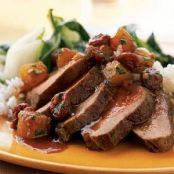
4.Remove the breasts to a cutting board and slice on the bias into strips. Serve with cranberry compote, pea shoots, and Okinawan sweet potatoes roasted in duck fat.
You'll also love
-
 Sour Orange, Red Cabbage and...
0/5
(0 Votes)
Sour Orange, Red Cabbage and...
0/5
(0 Votes)
-
SWEET BOURBON CORN PUDDING
0/5
(0 Votes)
-
PINEAPPLE BRULEE
0/5
(0 Votes)
-
Beef Rouladen Recipe
0/5
(0 Votes)
-
Cuban Pulled Pork Tacos with Guava...
0/5
(0 Votes)
-
Beef/Venison Stew (LL Bean...
0/5
(0 Votes)
-
Baked Asian Pears
0/5
(0 Votes)
-
Veal Florentine
0/5
(0 Votes)
Review this recipe