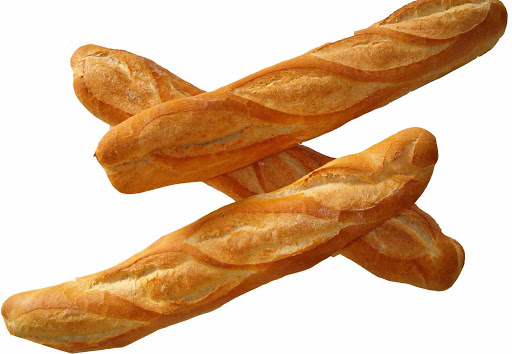
 1 Picture
Ingredients
- Poolish:
- 150 grams bread flour
- 150 grams cool water (65 degrees)
- small pinch of instant yeast (if dry yeast, melt in warm water)
- Dough:
- 470 grams all-purpose flour (King Arthur brand)
- 280 grams water
- 12 grams fine sea salt
- 3 grams instant yeast
- 235 grams of poolish
Details
Preparation
Step 1
General Procedure:
1. Preferment
2. Mixing / Kneading
3. Fermentation
4. Dividing
5. Pre-shaping
6. Resting
7. Final Shaping
8. Proofing
9. Steaming / Baking
10.Cooling
Preferment:
Start poolish 12 hours ahead of actual dough making. Mix bread flour with cool water and pinch of instant yeast. If using dry instant yeast - melt in warm water first. Place in bowl and cover with plastic wrap and let sit at room temperature for 12 hours. You can also refrigerate it for 12 hours if not ready to make the dough. (Note: instant yeast will last only for about 6 months).
The poolish is ready if you take a small pinch and it floats on top of a bowl of water.
Mixing and Kneading:
Using a large bowl, create the dough by mixing the all-purpose flour, sea salt, yeast, with water and the poolish. When all the flour is incorporated into a ball of dough, place onto a floured board.
Knead the dough: fold over to the middle and knead down. Keep kneading for several minutes until it passes the windowpane test. For the test, take a small pinch of dough and slowly stretch it with your fingers, turning it around and around, until you can stretch it to an almost translucent rectangle. If it breaks easily, then it's not ready - keep kneading. If it stretches to a thin rectangle without breaking, then the dough is kneaded enough.
(The windowpane test is meant only for the kneading-process baguette. If using the fold-over technique (Tartine version), do not use this test).
Fermentation:
Place a floured cloth over the bowl. Place the kneaded dough into the floured cloth. Let dough rest for 1 hour and then punch down. Keep fermenting for another hour - total fermentation is 2 hours. After fermentation, you can refrigerate for up to 2 days until you are ready to bake.
Dividing:
Divide the dough with a dough cutter according to the size bread that you want. If you want to create a long baguette (16"-24" long), divide dough into 300 gram pieces. Use a scale to weigh it. For demi-baguettes - about 8" long - divide dough into 150 gram pieces.
Pre-Shaping:
Flour hands first and flour the board. For long baguette, take the 300 gram dough and roll it into a football shape. For a demi-baguette, roll into a small round ball (use palm of hand and roll dough in a counter-clock wise circle if right-handed. If left-handed, roll in a clockwise circle).
Resting:
Let dough rest for 20 minutes.
Final Shaping:
First create a line of flour on your board - using your flour cutter - that is 1" wide and the length of the baguette that you are making.
For long baguette:
Take the football shape, and fold the long length over to the middle. Using your left hand, take your thumb and starting at the right end of the shape, lift up at the seam, and press down with the palm of your right hand. Work from the right to the left of the roll: lift up with left thumb, and press down with your right palm. You are de-gasing the dough.
Then take both palms of your hands, starting in the middle and working towards the ends, roll out the dough until you have a baguette that is 16" long (or longer). Pick up the dough and dip onto the flour line and transfer to the couche-lined tray (see below).
For demi-baguette:
Take the ball of dough, and flatten with the palm of your hand. Take the top of the circle and fold 2/3 down. Then fold the bottom upwards until you create a rectangle. Then taking your fingers, lift the top left and right corners of the rectangle and fold inward to the middle until a triangle is formed. Take the top of the triangle and fold over until a mini-football shape is formed.
Then with the palms of your hands, roll this shape out, starting in the middle, working towards the ends,into an 8" long baguette. Lift up and dip onto the line of flour and transfer to the couche-covered tray.
Proofing:
Take a linen cloth and cover a baking tray. Take the long end of the cloth and roll into a tight cylinder, touching the edge of the tray - this is the couche. Then flour the linen cloth with rice flour and rub it in. After you transfer the baguette to this couche, touching the rolled end, bunch up the cloth to create a U-shaped channel to hold the baguette shape into place. Keep creating the channels until you hold all the baguette forms. Then cover with a damp cloth and proof for the final rise for one hour. The dough is ready when you poke at the end with your finger and it holds the indentation.
DO NOT OVER-PROOF. If you over-proof the dough, the bread will not rise.
When you are finished proofing, take the lame (or any razor edge), and score the baguette diagonally a few inches apart, 3 or 4 scores for the long baguette. For the demi-baguette, just use two scores.
Steaming / Baking:
Preheat oven to 500 degrees while you are doing the final proof. Allow oven to preheat for 30 minutes. If using a baking stone (or ceramic tile), preheat oven for an hour before baking. Just before baking, heat a cup of water just to boiling for a steam bath. While the water is heating up, take the baguettes and lift with a plastic-wrapped long cardboard (same length as your baguette) and flip onto a pizza peel (server) or use a parchment lined flat baking sheet - no lip. Put two baguettes onto the server and unload onto the ceramic tile or baking stone (seam side down). Pour hot water onto a baking pan and place under the baking stone. Keep transferring baguettes to the baking stone - about 2 inches apart.
Take a spray bottle of lukewarm water, and spray the tops of the loaves for about 3 seconds. This will create the even brown crust. For the first five minutes of baking, keep spritzing the loaves with water a couple of times. Then reduce oven temperature to 450 degrees. Bake for 20 minutes, and rotate the breads (or pan) and bake for an additional 5 to 10 minutes until the top of bread is golden brown. With a dry towel, turn the bread over and tap its bottom. It should sound hollow.
Cooling:
Let cool for 10-15 minutes for demi-baguettes, about 20-30 minutes for the long baguettes. This will allow the steam to be released and also the carbon dioxide from the bread. Do not skip this step as if you cut too early, the baguette will be too chewy.
Final Notes:
For the best baguettes, the crumb structure inside should be shiny rather than matte. To create the shiny crumb structure, use a slower fermentation process.
Tartine version:
Tartine's baker, Chad Robertson, uses the fold-over technique rather than the kneading process. He also has a longer fermentation time - about 3 hours - to create the gluten. (Kneading also creates the gluten).
Review this recipe