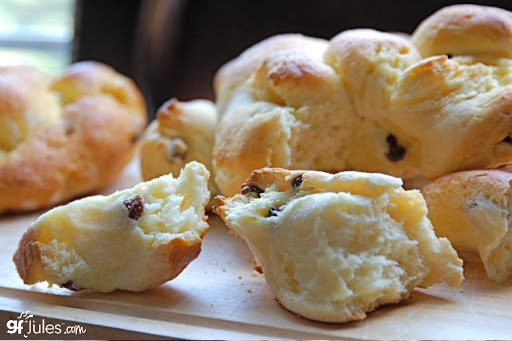
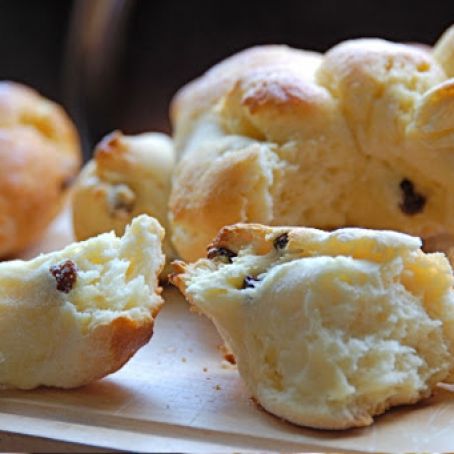
Challa Bread, GF
By MaryEllen
No matter what your reason for making this delicious bread, celebrate that this impressive recipe is at your gluten-free fingertips anytime you feel like having a sweeter day.
 2 Pictures
Ingredients
- 1/3 – 1/2+ cup warm water
- 1 package rapid rise gf yeast (Red Star®)
- 1 tsp. granulated cane sugar
- 1 cup vanilla dairy or non-dairy yogurt, at room temperature (So Delicious® Vanilla Coconut Yogurt)*
- 1 tsp. apple cider vinegar
- 5 large egg yolks at room temperature (slightly mixed)
- 1/3 cup non-GMO canola oil or coconut oil (warmed to liquid) or extra virgin olive oil
- 4 Tbs. honey, agave nectar or molasses
- 4 cups gfJules™ All-Purpose Flour
- 3 Tbs. + 2 tsp. granulated cane sugar
- 1 1/4 tsp. kosher salt
- 1/2 tsp. baking soda
- 2 tsp. gluten-free baking powder
- 1 large egg, mixed
- poppy seeds, sesame seeds, raisins, or other topping or mix-in (optional)
- If you don’t have yogurt on-hand, another good substitute is sour cream.
Details
Adapted from gfjules.com
Preparation
Step 1
Preheat your oven to 200º F, then turn it off; if you have a warming drawer, you may set that to low/moist setting instead. Prepare a baking sheet by lining it with parchment paper.
In a small bowl, mix together the warm water (start with 1/3 cup), yeast and 1 teaspoon of sugar to proof the yeast; set aside.
In the bowl of your stand mixer, add the remaining wet ingredients and mix until combined. Whisk together the dry ingredients in a separate bowl.
After 5 minutes of proofing, stir in the yeast-water mixture into the wet ingredients (note: if your yeast isn’t bubbling at this point, throw it out and start again with fresh yeast). Gradually stir in the dry ingredients until fully integrated, adding more warm water by the tablespoon as needed to get the dough soft and so that the dough is not tight or stiff — you should be able to pull the dough gently without it feeling tight or like it would bounce back — if it’s stiff, then add more warm water then mix 1-2 minutes more on medium speed.
Using either method, once the dough is combined, divide it in half and divide each half into three equally-sized balls. The dough will be sticky, so use extra gfJules™ flour on your hands and rolling surface (I like using a bench scraper like this one to help me cut and roll the sticky dough).
Roll each ball out into an 18-inch coil or log on a clean, flat surface dusted lightly with gfJules™ Flour. Pinch together one end of each coil, wetting them slightly with water to help them join together at the top, then braid them, finishing by connecting them to the top of the other end in order to form a crown, or circular shape, or simply leave as a long braid.
Gently transfer it to the parchment-lined baking sheet. Repeat for the second set of three balls. In the alternative, you can simply divide the dough in half, roll out into a flattened coil, then twist upon itself and join at the ends to form a circular loaf; repeat with the other half of the dough ball.
In a small bowl, mix the extra egg together and brush over each loaf well, coating the entire top surface. Sprinkle the seeds or any toppings at this point, then place the tray (covering the loaves with wax paper sprayed with cooking oil) in a warming drawer set to low heat, or into the preheated oven for approximately 20 – 30 minutes. (Don’t expect the bread to rise much at this stage).
Once risen slightly, place the uncovered tray in an oven preheated to 350º F (static) or 325º F (convection) for 20 minutes or until a toothpick inserted into the center of the bread comes out dry, or with some crumbs attached but no wet dough.
Remove to cool on a wire rack.
Review this recipe