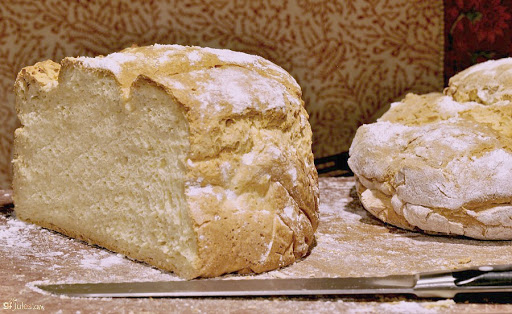
Artisan GF Bread
By MaryEllen
 1 Picture
Ingredients
- toppings:
- 3 3 3 cups gfJules™ All-Purpose Gluten-Free Flour
- 1/4 1/4 1/4 cup flax seed meal (or GF buckwheat; millet; sorghum or brown rice flour)
- 1/4 1/4 1/4 cup dry milk powder, OR almond meal
- 1/2 1/2 1/2 tsp. baking soda
- 2 2 2 tsp. baking powder
- 1 1 1 tsp. sea salt
- 1 1 1 tsp. apple cider vinegar
- 2 2 2 Tbs. honey, agave nectar or coconut palm nectar
- 1 1/4 1 1/4 1/4 cup room temperature liquid: EITHER plain yogurt* OR milk (not skim) OR sparkling water OR ginger ale OR gluten free beer (bubbly liquids make the bread rise higher and lighter)
- 1/4 1/4 1/4 cup extra virgin olive oil
- 2 2 2 10 6 (OR 2 Tbs. flax seed meal steeped for 10 minutes in 6 Tbs. hot water)
- 2 1/4 2 1/4 1/4 tsp. (one packet) rapid rise or bread machine yeast, gluten-free (Red Star Quick Rise®) – comes with gfJules™ Sandwich Bread Mix
- 1 1 1 Tbs. flax seeds or sesame seeds
- 1 1 1 Tbs. coarse sea salt
- to to to to this thick dough to the consistency needed to spread out to form a nice loaf.
Details
Adapted from gfjules.com
Preparation
Step 1
If baking from scratch, whisk these dry ingredients together in a large bowl: flours, milk powder, baking soda, baking powder, and salt. Set aside.
In the large mixing bowl of a stand mixer, stir together the wet ingredients (honey, yogurt, apple cider vinegar, oil, and egg or flax seed and water mixture). Gradually add the dry ingredients (or gfJules Gluten Free Sandwich Bread Mix packet) in with the wet by pouring slowly into the wet bowl while mixing with the paddle attachment. Once incorporated, add the yeast granules, and beat well – 1-2 more minutes.
The dough will be very thick (much more like regular wheat flour bread dough than you may be used to with gluten free); however, if the dough seems too thick to spread into a loaf pan, gradually mix in more yogurt, one tablespoon at a time, until the dough is still thick, but able to be smoothed with a spatula.
Liberally dust a pastry mat or clean counter with more gfJules flour and transfer the dough onto the surface, rolling gently in the flour to cover all sides. Knead slightly, if necessary, to form a smoother ball.
Transfer to a parchment-lined baking sheet. Wet a large serrated knife and press into the bread in 2 or 3 lines, rocking the knife back and forth to open the cuts slightly wider. This will give the bread natural rifts to rise from, and make it even prettier once baked.
Cover loosely with a piece of oiled parchment paper and place in a warm spot to rise for 30 minutes – 1 hour.
Spritz with water once risen, if you prefer an even crunchier crust.
Preheat oven to 350º F (static) or 325º F (convection) and bake for 35-45 minutes, testing with an instant read thermometer to ensure it’s fully baked before removing from the oven. The thermometer should have reached 200º F.
Remove to cool on a wire rack.
If baking with another liquid:
The dough will be more batter-like, so it still needs some support while rising and baking. Choose an oven-safe deep, round pan or bowl, pyrex, or even a springform pan. Line with parchment and transfer the dough to the pan, smoothing the top with a spatula and mounding it more in the middle of the pan rather than flattening it out.
Wet a large serrated knife and press into the bread in 2 or 3 lines, rocking the knife back and forth to open the cuts slightly wider. This will give the bread natural rifts to rise from, and make it even prettier once baked. Lightly dust the top with more gfJules flour.
Cover loosely with a piece of oiled parchment paper and place in a warm spot to rise for 30 minutes – 1 hour.
Spritz with water once risen, if you prefer an even crunchier crust.
Preheat oven to 350º F (static) or 325º F (convection). For more rounded loaf, lift up on parchment and remove the risen dough from the pan. Lay parchment with risen dough on top of a flat baking sheet. Otherwise, leave dough inside the pan for support.
Remove to cool on a wire rack for 10 minutes; if baked in a pan, lift up on the parchment paper and remove the bread to finish cooling out of the pan on a wire rack.
Slice when fully cooled.
Review this recipe