
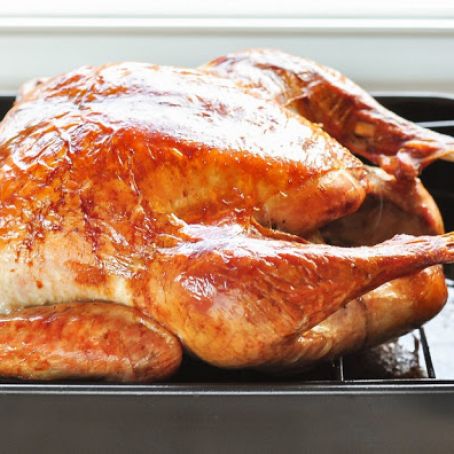
Dry-Brined Roasted Turkey
By cortanez
 1 Picture
Ingredients
- 3 tablespoons kosher salt
- 1 1/2 teaspoons dried herbs, such as thyme, sage, and rosemary, or blend
- 3/4 teaspoon freshly ground black pepper
- 1 stick of butter
- 1 (14-to-16 pound) thawed whole turkey (not kosher or pre-salted)
Details
Servings 1
Adapted from thekitchn.com
Preparation
Step 1
Mix the dry brine together:
Mix the salt, pepper, and herbs together in a small bowl.
Take the turkey out of the packaging and place on a cutting board. Remove the giblets and neck from inside the cavity and discard or save for another use. Remove or discard any plastic or metal cages or pop-up thermometers.
Sprinkle 2 teaspoons of the salt mixture into the cavity of the turkey.
Rub another 2 teaspoons of the salt mixture into the meat of the legs (under the skin). Rub 4 teaspoons of the salt mixture into the meat of the breasts (under the skin).
Sprinkle the remaining salt mixture over all the skin of both the breasts and legs.
Place the turkey breast-side up in a rimmed baking sheet or roasting pan and refrigerate uncovered for at least 1 day but ideally 3 days. You do not need to pat it dry before cooking — it's ready to be roasted.
Prepare the turkey for roasting: Thirty minutes to an hour before roasting, take the turkey out of the fridge. Set the turkey breast-side up on the roasting rack and let it sit while the oven preheats. This takes the chill off the meat, which helps the meat cook faster and more evenly. It also gives the skin time to dry out, which promotes browning and crisping. (Note: Your turkey will likely still feel cool to the touch after sitting at room temperature — that's fine and you can continue on with roasting.)
Preheat the oven to 450°F: Position an oven rack in the bottom third of your oven and preheat the oven to 450°F.
Heavily coat turkey with the butter. Remember to put butter under the skin as well. Truss the legs together so that they aren't sticking out and tuck the wings in. Stuff the cavity of the turkey with onions, celery, carrots, and fresh poultry blend spices.
Add liquid to the roasting pan: When ready to roast, pour two cups of broth or water into the roasting pan.
Place the turkey in the oven and turn down the heat: Place the turkey in the oven and turn down the heat to 350°F. Shield the breast meat with foil toward the end of cooking if it starts getting too browned.
Roast the turkey: The rule of thumb for cooking a turkey is 13 minutes per pound. So our 16-pound turkey was estimated to cook in about 3 1/2 hours. Plan on the 13-minute-per-pound rule, but start checking the temperature of your turkey about halfway through the scheduled cooking time to gauge how fast it's cooking.
Check the turkey's temperature: Begin checking the turkey's temperature about halfway through the estimated cooking time. Check the temperature in three places: the breast, outer thigh, and inside thigh (see photos above). In every case, the meat should be at least 165°F when the turkey has finished cooking. If any place is under that temperature, put the turkey back in the oven for another 20 minutes. Shield the breast meat with foil if needed to keep it from overcooking.
Rest the turkey before carving: Grab one side of the roasting rack with an oven mitt and tilt the whole pan so the liquids inside the turkey cavity run out into the pan. (These juices are used to make the gravy.) Then, lift the whole turkey (still on the rack) and transfer it to a cutting board. Tent the turkey with aluminum foil and let it rest for at least 30 minutes. This gives time for the meat to firm up and the juices to be re-absorbed into the muscle tissue, making the turkey easier to slice and taste juicier.
Carve the turkey: Carve the turkey the same way you would carve a chicken. Remove the wings first, then the thighs, then the breast meat. Once you have the meat off, you can separate the thighs into thighs and drumsticks and carve the breast meat into individual slices.
Review this recipe