 1 Picture
Ingredients
- Chef Anne's All-Purpose Pasta Dough:
- 4 slices bacon
- 10 leaves plus 2 sprigs fresh sage
- Kosher salt
- 2 cups ricotta cheese
- 1 cup freshly grated Parmigiano, plus more for garnish
- 1/4 cup chopped fresh Italian parsley
- 2 large eggs plus 4 large egg yolks (all heirloom or organiceggs)
- All-purpose flour, as needed
- 1/2 recipe Chef Anne's All-Purpose Pasta Dough, rolled forravioli, (recipe follows)
- Semolina flour, as needed
- 1 1/2 sticks unsalted butter
- 1/2 cups chicken stock
- 1 pound all-purpose flour
- 4 whole eggs, plus 1 egg yolk (all heirloom or organic eggs)
- 1/4 cup extra-virgin olive oil
- 1 to 2 tablespoons water or more if needed
- Kosher salt
- Variation from Food and Wine (Serves 8):
- pasta dough
- 2 large eggs
- 4 large egg yolks
- 2 cups (10 ounces) 00 flour
- filling
- 8 ounces soft sheep-milk feta cheese, such as Bulgarian or Spanish
- 8 ounces whole-milk ricotta
- 1/2 cup (1 ounce) freshly grated Pecorino Romano cheese
- 1/2 teaspoon grated orange zest
- 1 tablespoon chopped parsley
- 2 teaspoons chopped oregano
- Kosher salt
- tomato sauce:
- 4 pounds ripe tomatoes, halved
- 6 tablespoons extra-virgin olive oil
- 1 garlic clove, minced
- 1 pinch of crushed red pepper
- Kosher salt
- ravioli:
- Semolina, for dusting
- 8 large egg yolks
- 3 large egg whites, beaten
- 1 cup torn basil leaves, plus small leaves for garnish
- Shaved Pecorino Romano cheese for garnish
Details
Servings 4
Adapted from foodnetwork.com
Preparation
Step 1
To a saute pan over medium-high heat, add the bacon and render until crispy. Remove from the heat and place onto a paper-towel-lined plate. To the bacon fat, add the sage leaves and fry until crispy, about 30 seconds. Season the sage leaves with salt. Finely chop the bacon, crumble the sage and set aside. Reserve for garnish.
In a medium bowl, combine the ricotta, Parm, parsley and 2 whole eggs; mix well and sprinkle with salt.
Dust a clean work surface lightly with all-purpose flour and lay out 2 sheets of pasta about 12 inches long; brush lightly with water. Equally space 4 dollops of the ricotta mixture on one of the pasta sheets. Then use a spoon to make a nest or small hole in the center of each dollop. Carefully separate the remaining eggs and put a yolk in each ricotta nest; the ricotta should lovingly nestle each yolk (if a yolk breaks, scoop it out with a spoon and don't use it).
Cover the ricotta nests and egg yolk with the remaining pasta sheet. Use your index fingers to press around each ricotta nest to seal the edges. Then use a fluted ring cutter or dough roller to cut around each ravioli (they should be 3 to 4 inches in diameter). Reserve the ravioli on a tray generously dusted with semolina.
Bring a large pot of well-salted water to a boil. In a large saute pan, melt the butter and chicken stock. Add the sage sprigs and season with salt. Bring this to boil (BTB) and reduce to simmer (RTS).
Add the ravioli to the boiling water and cook for about 2 minutes, no more. Using a spider and slotted spoon, carefully transfer the ravioli from the water to the pan with butter and chicken stock and cook for 2 to 3 minutes. If the sauce reduces too much, add a few drops of the pasta cooking water. The sauce should cling to the ravioli in a buttery hug.
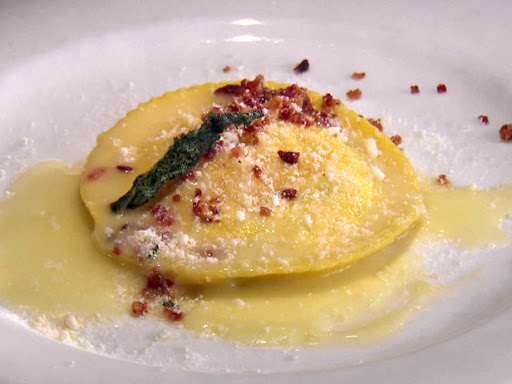
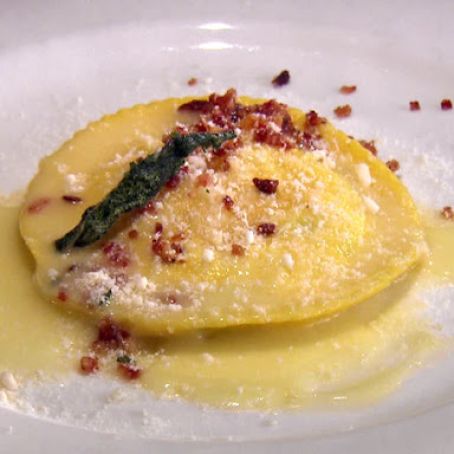
Transfer the ravioli to serving plates, one per plate. Spoon a little extra sauce over each one, and finish with a sprinkey-dink of grated Parm, the bacon and then the fried sage.
For the Pasta:
Put the all-purpose flour on a clean, dry work surface. Make a hole (this is also called a well) in the center of the flour pile that is about 8 inches wide (bigger is definitely better here). Crack all of the eggs and the yolk into the hole and add the olive oil, water and salt.
Using a fork, beat the eggs together with the olive oil, water and salt. Using the fork, begin to incorporate the flour into the egg mixture; be careful not to break the sides of the well or the egg mixture will run all over your board and you will have a big mess! Also, don't worry about the lumps. When enough flour has been incorporated into the egg mixture that it will not run all over the place when the sides of the well are broken, begin to use your hands to really get everything well combined. If the mixture is tight and dry, wet your hands and begin kneading with wet hands. When the mixture has really come together to a homogeneous mixture, THEN you can start kneading.
When kneading it is VERY important to put your body weight into it, get on top of the dough to really stretch it and not to tear the dough. Using the heels of your palms, roll the dough to create a very smooooooth, supple dough. When done the dough should look VERY smooth and feel almost velvety. Kneading will usually take from 8 to 10 minutes for an experienced kneader and 10 to 15 for an inexperienced kneader. Put your body weight into it, you need to knead! This is where the perfect, toothsome texture of your pasta is formed. Get in there and have fun!
When the pasta has been kneaded to the perfect consistency, wrap it in plastic and let rest for at least 1 hour. If using immediately do not refrigerate.
Roll and cut the pasta into desired shape.
Variation:
Make the pasta dough
In a small bowl, whisk the eggs with the egg yolks and 1/4 cup of water. Mound the flour on a work surface, make a well in the center and add the eggs. Using a fork, gradually draw in the flour until a dough forms. Gather and knead the dough until smooth. Form into a ball, cover in plastic wrap and refrigerate for 1 hour.
Meanwhile, make the filling
In a food processor, pulse the feta until smooth. Scrape into a medium bowl and add the next 5 ingredients. Mix until well blended and season with salt. Refrigerate until ready to use.
Make the tomato sauce
Grate the tomato halves on the large holes of a box grater set in a bowl until only the skins remain; discard the skins. In a large saucepan, heat the olive oil. Add the garlic and cook over moderate heat, stirring, until fragrant, about 2 minutes. Add the grated tomatoes and crushed red pepper and season with salt. Cook over moderate heat, stirring occasionally, until the sauce has thickened and reduced to 3 cups, about 20 minutes.
Make the ravioli
Divide the pasta dough into 4 pieces. Work with 1 piece at a time, keeping the rest covered. Press the dough to flatten it slightly. Run the dough twice through a pasta machine at the widest setting. Run the dough through 4 successively narrower settings, twice per setting, until the dough is about 1/16 inch thick. Dust a work surface with semolina and lay the pasta sheet on top; dust the pasta generously with semolina and cover with a damp kitchen towel. Repeat with the remaining 3 pieces of pasta dough, keeping the rolled-out sheets covered.
Lay one of the pasta sheets on a work surface and brush off the semolina. Spoon four 1/4-cup mounds of the cheese filling onto the pasta sheet about 4 inches apart. Spread the mounds of filling into 3-inch rounds and make a small well in the center of the filling. Slip 1 egg yolk into each well. Brush around the filling with the beaten egg whites. Drape another sheet of pasta on top and press around the fillings to push any air pockets out of the ravioli. Using a 4-inch fluted cookie cutter, stamp out the ravioli. Press the edges to make sure they are sealed. Transfer the ravioli to a semolina-dusted baking sheet. Repeat to form another 4 ravioli; reserve any remaining filling for another use.
Bring a large pot of water to a boil and season generously with salt. Reheat the tomato sauce in the saucepan. Using a slotted spoon, add 4 of the ravioli to the boiling water and cook until the pasta is al dente, about 3 minutes. Using a slotted spoon, transfer the ravioli to the tomato sauce. Add half of the torn basil and cook, stirring gently, until nicely coated, about 1 minute. Transfer the ravioli to plates and spoon some of the sauce on top. Repeat with the remaining 4 ravioli and torn basil. Garnish with Pecorino Romano and basil leaves and serve.
Make Ahead:
The filling and tomato sauce can be stored separately in the refrigerator for 3 days. The formed ravioli can be covered and refrigerated for 3 hours.
Review this recipe