
A Thoroughly Reliable and Tasty Piecrust (from King Arthur Flour)
Hands-on time:
15 mins. to 20 mins.
Total time:
15 mins.
Yield:
Two piecrusts, enough for 2 single-crust pies or 1 double-crust pie
"Tips From Our Bakers" from King Arthur Flour website:
*Can you use King Arthur Unbleached All-Purpose Flour in place of the Mellow Pastry Blend? Can you leave out the buttermilk powder? Yes; in both cases, the crust will simply be a bit less tender.
*Can you use buttermilk in place of the buttermilk powder? Yes; substitute ¼ ice-cold buttermilk for ¼ to 1/3 cup of the water.
*Can you use all butter instead of butter and shortening? Yes, the crust will be more crumbly/sandy, less flaky.
*Can you make all of these substitutions at once? Yes, and you'll have a different crust. Probably still tasty; just a different texture.
*Be sure to use cold butter and ice water when making the crust; it helps keep the butter and shortening from dispersing throughout the dough, which in turn helps keep the crust flaky.
*Can you make this crust ahead and freeze it? Absolutely. For a double-crust pie, make it up to the point where the two dough disks are wrapped in plastic and ready to chill; add an over-wrap of aluminum foil, and freeze for up to 2 months. For two single-crust pies, roll each chilled crust, and place in a metal pie pan. Trim, crimp, wrap the pans well in plastic, and freeze.
 1 Picture
Ingredients
- CRUST
- 10 ounces King Arthur Mellow Pastry Blend
- 1 teaspoon salt
- 1 teaspoon baking powder
- 1/2 ounce confectioners' sugar
- 1/2 ounce buttermilk powder
- 1 5/8 ounces vegetable shortening
- 5 ounces very cold unsalted butter
- 1 teaspoon vinegar, cider or white
- 3 1/2 to 5 ounces ice water
- TOPPING
- 1 teaspoon milk
- 1 tablespoon coarse sparkling sugar
Details
Adapted from kingarthurflour.com
Preparation
Step 1
1) Whisk together the Mellow Pastry Blend, salt, baking powder, confectioners' sugar, and buttermilk powder.
2) Add the shortening, working it in till the mixture is evenly crumbly.
3) Cut the butter into small (about 1/2") cubes.
4) Add the butter to the flour mixture, and work it in roughly with your fingers, a pastry cutter, or a mixer.
5) Don't be too thorough; the mixture should be very uneven, with big chunks of butter in among the smaller ones.
6) Add the 1 teaspoon vinegar and 4 tablespoons water, and toss to combine.
7) Toss with enough additional water to make a chunky, fairly cohesive mixture.
8) It should hold together when you gather it up and squeeze it in your hand.
9) Divide the dough in half, and gather each half into a rough disk.
10) Smooth the disks; it's OK if they have a few cracks in the surface.
11) Smooth the disks' edges by running them along a floured surface like a wheel.
12) Wrap in plastic, and chill for 30 minutes, or up to overnight. Or wrap in aluminum foil over the plastic, and freeze for up to 2 months.
13) When you're ready to make pie, remove the crust from the refrigerator or freezer, leaving it wrapped. Allow it to thaw (if it's frozen) or warm a bit (if it's been chilled longer than 30 minutes), till it's softened enough to roll, but still feels cold to the touch.
14) Next, measure the bottom diameter, and up the sides of your pie pan. If your pan is 7" across the bottom, and 1 1/2" up each side, that's a total of 10?. This means you should roll your bottom crust to a diameter between 11" and 12", which gives you enough extra for crimping the edges.
15) Place the crust on a floured work surface; our silicone rolling mat is a fine choice. Roll it to the desired width. See the big chunks of butter? That's a good thing.
16) Place the crust in the pan by folding in quarters and placing in the pan.
17) Or you can simply pick it up with a pie-crust lifter, and move it that way.
18) For a single-crust pie, fold the edges of the crust under, and gently squeeze them together.
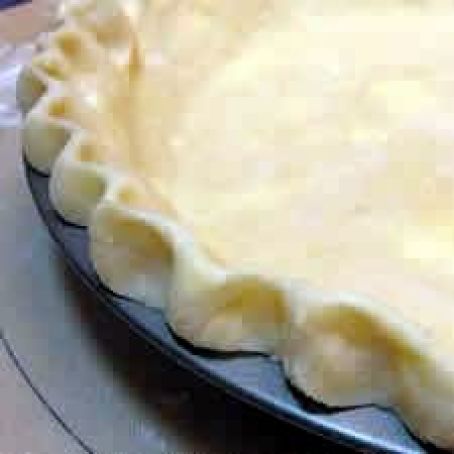
19) Crimp as desired. It's nice to make a tall crimp, as the filling for a single-crust pie is usually fairly liquid (think pumpkin or custard), and it's good to have that tall "dam."
20) You can easily make a nice tall crimp with your fingers, as shown.
21) It'll look like this.
22) For a double-crust pie, leave the edges of the bottom crust as is (no folding or crimping). Once you've added the pie filling, roll out the top crust to the outside diameter of your pan, and place it atop the filling.
23) Trim excess crust with a pair of scissors, then press the two edges together.
24) Crimp as desired. A simple fork crimp is fast and easy.
25) Cut a hole in the center of the crust for steam to escape. Or slash the pie's top surface several times.
26) Brush with milk and sprinkle with coarse sparkling sugar, if desired.
27) Bake... enjoy!
Review this recipe