
Artisan Boule Bread - 5 minutes a day
By Nitaj3
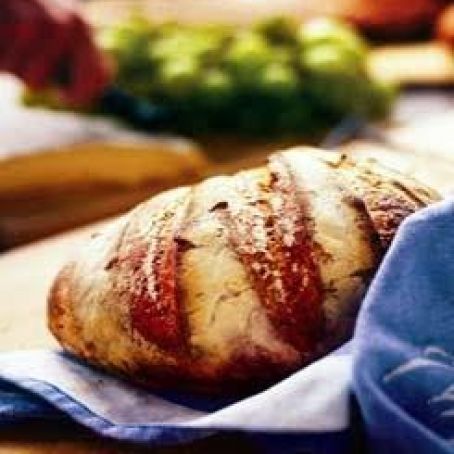 1 Picture
Ingredients
- 3 cups lukewarm water
- 1 1⁄2 tbsp granulated yeast (1 1⁄2 packets)
- 1 1⁄2 tbsp coarse kosher or sea salt
- 6 1⁄2 cups unsifted, unbleached, all-purpose white flour
- Cornmeal for pizza peel
- Ingredients and Equipment
- Great breads really only require four basic ingredients: flour, water, yeast and salt. The rest is detail. Here’s a short guide to the basic ingredients and equipment you’ll need to make artisan loave
- Unbleached, white, all-purpose flour: Has adequate protein (around 10 percent) to create a satisfying “chew,” but low enough to prevent heaviness. We prefer unbleached flours because bleaching removes
- Whole wheat flour: Contains the germ and bran, both of which are healthful and tasty. Together they add a slightly bitter, nutty flavor that many people enjoy.
- Bread flour: For chewier bread, substitute bread flour (about 12 percent protein) for all-purpose white flour by decreasing the amount slightly (by about a quarter cup for every 6 cups of all-purpose)
- Yeast: Use what's readily available.
- Salt: Use noniodized coarse kosher or sea salt.
- Baking stone: Use a high-quality, half-inch-thick stone. The porous stone absorbs moisture from your dough, allowing a thin, crackling, crisp crust to form — one of the keys to artisanal baking.
- Pizza peel: This long-handled board helps slide doughs onto a hot stone. A cookie sheet or cutting board will work, but will be more difficult to handle.
- Broiler tray: A pan to hold water for steam during baking.
Details
Preparation
Step 1
The artisan free-form loaf called the French boule is the basic model for all the no-knead recipes. The round shape (boule in French means “ball”) is the easiest to master. You’ll learn how wet the dough needs to be (wet, but not so wet that the finished loaf won’t retain its form) and how to shape a loaf without kneading. And you’ll discover a truly revolutionary approach to baking: Take some dough from the fridge, shape it, leave it to rest, then let it bake while you’re preparing the rest of the meal.
Keep your dough wet — wetter doughs favor the development of sourdough character during storage. You should become familiar with the following recipe before going through any of the others.
Mixing and Storing the Dough
1. Heat the water to just a little warmer than body temperature (about 100 degrees Fahrenheit).
2. Add yeast and salt to the water in a 5-quart bowl or, preferably, in a resealable, lidded container (not airtight — use container with gasket or lift a corner). Don’t worry about getting it all to dissolve.
3. Mix in the flour by gently scooping it up, then leveling the top of the measuring cup with a knife; don’t pat down. Mix with a wooden spoon, a high-capacity food processor with dough attachment, or a heavy-duty stand mixer with dough hook, until uniformly moist. If hand-mixing becomes too difficult, use very wet hands to press it together. Don’t knead! This step is done in a matter of minutes, and yields a wet dough loose enough to conform to the container.
4. Cover loosely. Do not use screw-topped jars, which could explode from trapped gases. Allow the mixture to rise at room temperature until it begins to collapse (or at least flatten on top), approximately two hours, depending on temperature. Longer rising times, up to about five hours, will not harm the result. You can use a portion of the dough any time after this period. Refrigerated wet dough is less sticky and easier to work with than room-temperature dough. We recommend refrigerating the dough at least three hours before shaping a loaf. And relax! You don’t need to monitor doubling or tripling of volume as in traditional recipes.
ON BAKING DAY
5. Prepare a pizza peel by sprinkling it liberally with cornmeal to prevent the loaf from sticking to it when you slide it into the oven.
Sprinkle the surface of the dough with flour, then cut off a 1-pound (grapefruit-sized) piece with a serrated knife. Hold the mass of dough in your hands and add a little more flour as needed so it won’t stick to your hands. Gently stretch the surface of the dough around to the bottom on four “sides,” rotating the ball a quarter-turn as you go, until the bottom is a collection of four bunched ends. Most of the dusting flour will fall off; it doesn’t need to be incorporated. The bottom of the loaf will flatten out during resting and baking.
6. Place the ball on the pizza peel. Let it rest uncovered for about 40 minutes. Depending on the dough’s age, you may see little rise during this period; more rising will occur during baking.
7. Twenty minutes before baking, preheat oven to 450 degrees with a baking stone on the middle rack. Place an empty broiler tray for holding water on another shelf.
8. Dust the top of the loaf liberally with flour, which will allow the slashing, serrated knife to pass without sticking. Slash a 1⁄4-inch-deep cross, scallop or tick-tack-toe pattern into the top. (This helps the bread expand during baking.)
9. With a forward jerking motion of the wrist, slide the loaf off the pizza peel and onto the baking stone. Quickly but carefully pour about a cup of hot water into the broiler tray and close the oven door to trap the steam. Bake for about 30 minutes, or until the crust is browned and firm to the touch. With wet dough, there’s little risk of drying out the interior, despite the dark crust. When you remove the loaf from the oven, it will audibly crackle, or “sing,” when initially exposed to room temperature air. Allow to cool completely, preferably on a wire rack, for best flavor, texture and slicing. The perfect crust may initially soften, but will firm up again when cooled.
10. Refrigerate the remaining dough in your lidded (not airtight) container and use it over the next two weeks: You’ll find that even one day’s storage improves the flavor and texture of your bread. This maturation continues over the two-week period. Cut off and shape loaves as you need them. The dough can also be frozen in 1-pound portions in an airtight container and defrosted overnight in the refrigerator prior to baking day.
TIPS TO AMAZE YOUR FRIENDS
The “6-3-3-13” rule. To store enough for eight loaves, remember 6-3-3-13. It’s 6 cups water, 3 tablespoons salt, 3 tablespoons yeast, and then add 13 cups of flour. It’ll amaze your friends when you do this in their homes without a recipe!
Lazy sourdough shortcut. When your dough container is empty, don’t wash it! Just scrape it down and incorporate it into the next batch. In addition to saving cleanup, the aged dough stuck to the sides will give your new batch a head start on sourdough flavor.
Variation: Herb Bread. Add a couple teaspoons of your favorite dried herbs (double if fresh) to the water mixture.
Review this recipe