Hainan Chicken Rice | Lucky Peach
By johnwhorfin
 1 Picture
Ingredients
- 1 whole 4-lb chicken
- + white pepper
- + kosher salt
- 4 scallions
- 1 " piece ginger, peeled, halved, smashed
- 2 cloves garlic, smashed
- 2 shallots
- 4 cloves garlic
- 1 " piece peeled ginger
- 2 " piece lemongrass
- 2 C jasmine rice
- 2 leaves pandan, tied into knots
- 2 T soy sauce
- 1 T sesame oil
- + chopped scallions
- + chopped cilantro
- + cucumber slices
- + water
- + a toothpick
- 2 cloves garlic, crushed
- 1 " piece peeled ginger, sliced
- + sugar
- + white pepper
- + kosher salt
- 1 shallot, roughly chopped
- 1 " piece peeled ginger, sliced
- 2 t minced fresh red chilies (arbol, bird’s eye, or Thai, seeded if you like)
- 2 cloves garlic, chopped
- 1 t calamansi lime juice
- 2 t chicken fat (skimmed from chicken poaching liquid)
- + kosher salt
- + sugar
Details
Servings 4
Adapted from luckypeach.com
Preparation
Step 1
Malaysia, a New Mexico–sized country shaped like angry eyebrows, is pinned on one end to the multi-culti Thai-and-Vietnamese peninsula and on the other to the northwestern reaches of the giant archipelago that is Indonesia (with the Philippines and Singapore and Brunei right there, too). Malaysians aren’t just Malays: they’re Indians, Chinese, indigenous people, and others. The country’s a melting pot—one stirred by Portuguese, Dutch, and British colonizers—to match any other.
Hainan is China’s Hawaii: its smallest and southernmost province, with a tropical climate similar to Malaysia’s. The Hainanese arrived in Malaysia after everybody else, beginning in the late 1800s, and many wound up as cooks for British families or at British military camps. Which is maybe why Hainanese-Malaysian food is the most fusiony: chicken chops, soft-boiled eggs with toast and coconut jam, coffee sweetened with condensed milk.
Hainan chicken rice is a dish you’ll find in any Southeast Asian country where there are Chinese immigrants. The basic method is universal: poach a chicken, then use the liquid to make rice. In Vietnam, it’s called Com Ga Hai Nam; in Thailand, it’s Khao Man Kai; in Cambodia, it’s Bai Mon. In Vietnam, you might add fish sauce and lime leaves; in Thailand, winter gourd; in Cambodia, fried garlic chips. The Malaysian method is to cook the rice with pandan leaves and lemongrass; it’s served with a chili sauce that’s sweet, sour, and fragrant with calamansi lime juice.
Makes 4 servings
Trim off any visible fat around the cavities of the chicken and reserve.
Bring 3 or 4 quarts of lightly salted water (enough to submerge the chicken) to an aggressive boil in a large pot. Meanwhile, rub the chicken with white pepper and about 1 tablespoon of salt, inside and out. Chop the scallions, and stuff them in the cavity of the chicken with the ginger and garlic. Poke a toothpick through the skin flaps to seal everything inside.
Once the water is boiling aggressively, put the chicken in the pot, breast side up, and cook for 10 minutes. Turn the heat off. Let the chicken sit in the pot with the heat off and lid on for 45 minutes.
Pound the shallot, garlic, and ginger together with a mortar and pestle. Give the lemongrass a few hard smacks with the broad side of a cleaver. Render the harvested chicken fat over medium-high heat in the pot you’ll cook your rice in. Add the lemongrass and shallot mixture to the pot and cook, stirring until everything is fragrant and browned on the edges.
Add the rice and give it a gentle toasting, stirring it around the pot with the aromatics to coat it in the chicken fat, about 2 minutes. Add 2 1/2 cups of the reserved poaching liquid (reserve the remaining) and pandan leaves, and cook the rice. If using a rice cooker, dump everything in, and follow your manufacturer’s instructions. If not, consider buying one while you bring the pot to a boil. Once it boils, put a lid on it, turn the heat down to low, cover, and simmer the rice undisturbed for 20 minutes. Then turn the heat off and let the pot sit for 10 minutes.
Boil the remaining poaching liquid with 2 cloves of garlic, your 1″ piece of ginger, and 2 teaspoons of sugar for 5 minutes. Add white pepper and additional sugar to taste. Taste and add salt if it needs it, or dilute it with water if it’s too salty. Strain. That’s your soup.
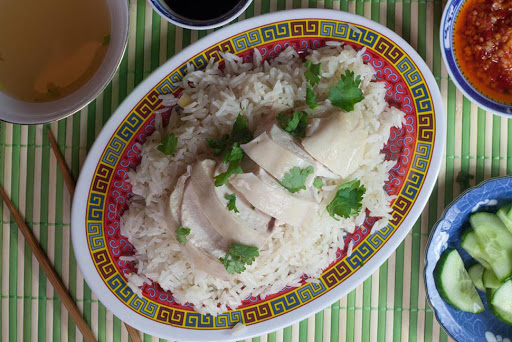
To serve: Rice goes on the plate first, then pieces of chicken. Drizzle the soy sauce and sesame oil over the chicken—so every piece gets a hit of soy and sesame—and sprinkle scallions and cilantro all over. Serve with cucumber slices and chili sauce. The soup is part of the package, too. Ladle into individual soup bowls and stir in scallions and cilantro before serving.
If there’s leftover soup, freeze it. Use that liquid for poaching your chicken the next time you make Hainan chicken rice. Your hundredth batch will be a hundred times better than your first.
Calamansi limes look like key limes, but they are fragrant and orange-yellow on the inside, with a taste that’s sort of akin to sour plums. Check Filipino grocery stores first. Use a key lime if you can’t find calamansis, but try. They make a big difference. They’re the next yuzu.
Blend everything—the shallot, ginger, chilies, garlic, calamansi juice, and chicken fat. You want the sauce well blended, but not so sriracha-smooth you can’t see chili pieces and seeds. Add a big pinch of salt and a bigger pinch of sugar and taste. If it’s bitter, add more sugar.
Review this recipe