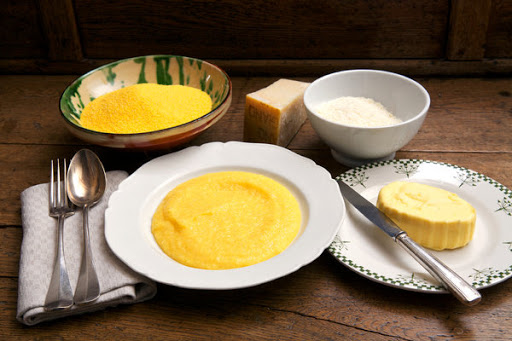
Basic Polenta
By ebdonahue
Polenta is basically cornmeal mush, and you can make it with any kind of cornmeal. Italian groceries stock the best brands, which can be ground coarse, medium or fine, all of which have the potential to be delicious. As with most ingredients, the better the cornmeal, the better the polenta.
The trick is cooking it for a sufficient amount of time (most people don’t). You must allow the cornmeal to swell and become fully cooked. That way, you emphasize the sweet corn flavor; uncooked cornmeal has an unpleasant bitter taste.
There’s no getting around the fact that you need nearly an hour to make real polenta, but it’s not such a chore. It does need a little nursing, but once you get the hang of it, you can almost do it in your sleep. Then you can start riffing.
In Italy, I’ve had a humble slice of polenta served with a meaty ragù in Bologna and cuttlefish stew in Viareggio. In Venice I had an extravagant dish in which polenta was adorned with black truffles and quail eggs.
I offer two simple suggestions here: grilling squares of polenta and serving them with eggs and a spicy tomato sauce, and baking the polenta with a rich stuffing of spinach and cheese.
Let’s talk a little bit more about how to cook it. I like to use the technique employed by grandmothers all over Italy: Bring a pot of water to a rapid boil and slowly pour in the cornmeal, whisking for 3 to 5 minutes until it thickens. Turn the flame very low, and let the polenta bubble gently. As the mixture cooks, it actually speaks, making little puffing sounds while sputtering air at the surface.
Despite what fanatics will advise, I stir it only every 10 minutes or so, or when I think of it, as opposed to constantly. The main thing is to check the moisture and to make sure it’s cooking evenly; if the polenta gets too thick, it won’t cook properly. Depending upon the cornmeal you use, you may need to stir in a little more water from time to time. The general proportions of water to cornmeal are 5 to 1 for soft polenta (best in a bowl topped with butter and Parmesan) and 4 to 1 for firm (best for grilling, baking or frying).
 1 Picture
Ingredients
- Salt and pepper
- 1 cup medium or fine cornmeal
- Butter
- Parmesan for soft polenta, optional
Details
Servings 6
Cooking time 60mins
Adapted from nytimes.com
Preparation
Step 1
For firm polenta use 4 cups water; for soft polenta use 5 cups water. Bring water to a boil in a medium-size heavy sauce pan over high heat. Add 1 teaspoon salt. Pour cornmeal slowly into water, stirring with a wire whisk or wooden spoon. Continue stirring as mixture thickens, 2 to 3 minutes.
Turn heat to low. Cook for at least 45 minutes, stirring every 10 minutes or so. If polenta becomes quite thick, thin it with 1/2 cup water, stir well and continue cooking. Add up to 1 cup more water as necessary, to keep polenta soft enough to stir. Put a spoonful on a plate, let it cool, then taste. Grains should be swollen and taste cooked, not raw. Adjust salt and add pepper if you wish.
For firm polenta, lightly butter a baking sheet or shallow dish, approximately 8 1/2 by 11 inches. Carefully pour polenta into pan. Using a spatula, spread polenta to a thickness of 3/4 inch. Cool to room temperature to allow polenta to solidify. Cover and refrigerate for up to 3 days. For soft polenta, add 6 tablespoons butter to pot and stir well. Serve immediately or transfer to a double boiler set over low heat, cover and keep warm for up to an hour or so. (Or set the saucepan in a pot of barely simmering water.) Stir well before spooning into low soup bowls. Sprinkle with Parmesan, if desired.
Review this recipe