Pavlova
By bjlazyl
 1 Picture
Ingredients
- 3 cups sugar
- 1 egg
- Juice and zest of 1 lemon
- 2 tbsp. unsalted butter, cubed, and chilled
- 1/4 cup cornstarch
- 1 tbsp. distilled white vinegar
- 1 tbsp. vanilla extract
- 8 egg whites, room-temperature
- 1 cup heavy cream, chilled
- 1/2 cup chilled plain yogurt
- Strawberries, halved
- Kiwi, peeled, and sliced
Details
Servings 1
Adapted from saveur.com
Preparation
Step 1
Few desserts are as pretty and as easy to make as a pavlova. For this one, we've combined the best elements of versions by New Zealand bakers Robyn Hedges and Pip Hoar. The key to success is patience: allow the meringue to cool completely before transferring it to the plate or cake stand. You'll prevent any crumbling that can occur when the process is rushed.
MAKES 1 PAVLOVA
1. Make lemon curd: In a small saucepan over medium heat, whisk together ½ cup of the sugar, 1 egg, and the juice and zest of the lemon; cook, whisking constantly, until thickened, 8–10 minutes. Remove pan from heat and whisk in unsalted butter, letting each cube incorporate before adding the next. Strain curd through a fine sieve set over a small bowl; press plastic wrap against the surface of curd and refrigerate until well chilled.
2. Make meringue: Heat oven to 350°. In a small bowl, stir together cornstarch, vinegar, and vanilla extract; set aside. In the bowl of a stand mixer fitted with a whisk, beat remaining 2½ cups of sugar and egg whites on low speed until combined. Increase speed to medium-high and beat until soft peaks form. Add cornstarch mixture to egg whites; continue beating until very stiff and glossy peaks form, about 5 more minutes.
3. Place a 9" round cake pan in the center of a 13" x 18" sheet of parchment paper and use a pencil to trace a circle around the outside of the pan. Flip the sheet of parchment paper and transfer it to a baking sheet so that the marked side is face down. Transfer meringue to the center of parchment paper.
5. In the bowl of a stand mixer fitted with a whisk, beat heavy cream and yogurt on medium-high speed until stiff peaks form. Pour the whipped cream mixture onto the cooled meringue and spread evenly over meringue's top using a rubber spatula.
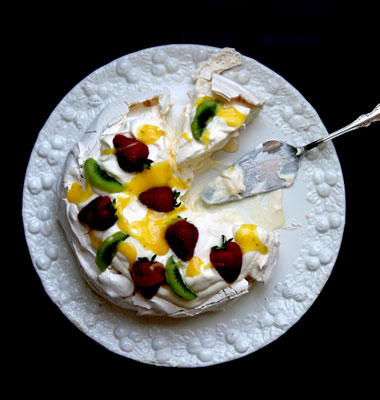
6. Decorate the top of the pavlova with strawberries and kiwifruit. Remove the reserved lemon curd from the refrigerator and stir vigorously; drizzle the curd over the pavlova, reserving a few tablespoons for individual servings. Cut the pavlova into slices and serve immediately with lemon curd.
I do confess...I have meringue-phobia when it comes to making them. But what do I have to lose? I followed the directions as written which I hardly do and voila...I DID IT!
The directions were very accurate and easy. The only thing I deviated from was the circumference of the disk. It was a tad bit wider than 9". It did not matter. The result: crispy surface and delectably soft in the inside.
The lemony curd complemented the fruit toppings. I will definitely make this again!
Regarding the curd: MAKE IT IN A DOUBLE BOILER! You are FAR less likely to face curdling.
I've made this several times and it's made a great impresion every time. It's beautiful, and is easy to make ahead so you can put it together quickly when you're ready to serve. The whipped cream and yogurt combination is a wonderful balance to the sweetness of the meringue and adding the yogurt gives the dessert a nice weight.
As a previous reviewer noted, the meringue makes a larger than expected circle, so allow for that when you choose a baking pan.
It is a lovely recipe, but it may not be possible to accomplish in a warm, humid climate. No matter how much I chilled the equipment and ingredients, the dang meringue could only be coaxed into very soft peaks. I was afraid I was going to kill my KitchenAid mixer. I had a similar experience with making marshmallows in October, a cool month.
Read more at: http://www.foodnetwork.com/recipes/ina-garten/mixed-berry-pavlova-recipe.html?oc=linkback
"In a small bowl, stir together cornstarch, vinegar, and vanilla extract; set aside."
Did your recipe testers actually follow this step? A small amount of liquid mixed with half a cup of cornstarch gives thixotropic lumps, which will not be as easily distributed through the egg whites.
Luckily, I'm Australian, so I knew to add the vinegar at the start of whisking, and sprinkle the (dry) cornstarch a tsp at a time, halfway through the whisking process.
Review this recipe