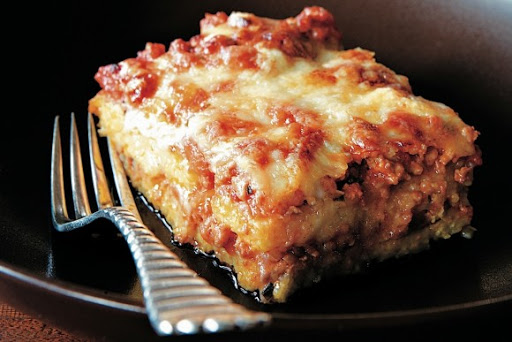
Polenta Lasagne
By CheeseDiva
Corn polenta has traveled the globe to become a staple in world-class restaurants. Yet for more than 400 years, it sustained the peoples of Italy’s poor northeastern regions. Its origins go back even further, to the pulmentum of the Romans that was a mainstay of the commoner. Prior to the 17th century — before corn was transplanted to Italy from the New World — this porridge was made from hulled and crushed grains of various kinds, including farro (also known in English as “emmer”), barley and millet as well as chestnut, fava bean or chickpea flour.
 1 Picture
Ingredients
- For the sauce:
- 6 tablespoons extra virgin olive oil
- 1 onion, minced
- 1 large clove garlic, minced
- 1 carrot, chopped
- 1 small celery stalk with leaves, chopped
- 1 teaspoon pulverized fennel seeds
- 1 pound ground pork
- 1/2 cup good-quality dry red wine
- 3 tablespoons tomato paste
- 1 (35-ounce) can plum tomatoes, drained, seeded and chopped, juices reserved
- 3 tablespoons minced fresh basil leaves
- 1 teaspoon fine sea salt
- For the polenta:
- 7 1/2 cups water
- 1 tablespoon kosher salt
- 2 cups fine- or coarse-grained imported Italian yellow polenta or “quick-cook” polenta
- Olive oil for preparing work surface and baking dish
- To assemble:
- 1/2 pound semi-soft pecorino such as Fior di Sardegna (or Manchego aged three to six months), shredded
Details
Servings 1
Adapted from zesterdaily.com
Preparation
Step 1
For the sauce:
1. Warm the oil in a skillet. Stir in the onion, garlic, carrot and celery and sauté over medium-low heat until vegetables are soft, 12 to 15 minutes.
2. Add the fennel seeds, pork and continue to sauté until the meat colors lightly, stirring occasionally, about 4 minutes. Stir in the wine and allow to evaporate (about 1 minute).
3. Dilute the tomato paste in a few tablespoons of the reserved canned-tomato juices and add it to the skillet, followed by the tomatoes with another 1/2 cup of the reserved juices, basil and salt. Stir well. Partially cover and simmer over the lowest possible heat for 1 hour, stirring frequently. The sauce should become thick and fragrant. If it seems to be drying out, add a few more tablespoons of the reserved tomato juices.
For the polenta:
1. While the ragù is simmering, bring the water to a boil in a large saucepan. (Keep a kettle of boiling water on the back burner should you need extra.) Add the salt.
2. Stirring constantly with a long-handled wooden spoon, add the polenta in a slow, constant stream to prevent lumps from forming. Simmer, stirring constantly, until the polenta is very thick and creamy and pulls away from the side of the pan, about 40 minutes. If you are using quick-cook polenta, you may need to add a little boiling water to ensure that it doesn’t get too thick. (You can also cook it longer than the instructions specify in order to obtain a creamy consistency — up to 20 minutes or so, adding more boiling water as needed.)
3. Use a rubber spatula dipped into hot water to spread the polenta out into a rectangle about 1/4-inch thick. Let set until cooled completely and firm, about 15 minutes. Cut into even 3-inch-by-4-inch rectangles; set aside. Lightly oil a 9-inch-by-13-inch baking dish.
To assemble:
1. Heat the oven to 450 F.
2. Arrange half the polenta pieces on the bottom of the baking dish. Top them with half of the sauce and spread to cover. Sprinkle half the cheese over the sauce. Repeat with another layer of sauce, followed by the remaining cheese. Bake until heated through and the cheese is golden brown, 15 to 20 minutes.
3. Let stand for 10 minutes. Cut into pieces and serve.
Main photo: Polenta pasticciata, in “Italian Home Cooking: 125 Recipes to Comfort Your Soul,” by Julia della Croce (Kyle Books). Credit: Hirsheimer & Hamilton
Zester Daily contributor Julia della Croce is the author of "Italian Home Cooking: 125 Recipes to Comfort Your Soul" (Kyle Books), "Pasta Classica" (Chronicle) and 12 other cookbooks.
Everything you ever wanted to know about olive oil. Enter here to win one of 10 copies!
Visit Zester Daily’s Bookstore »
Review this recipe