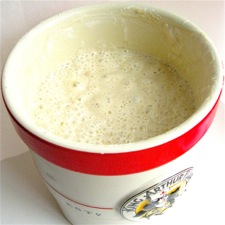
Sourdough Starter
By Nancylca
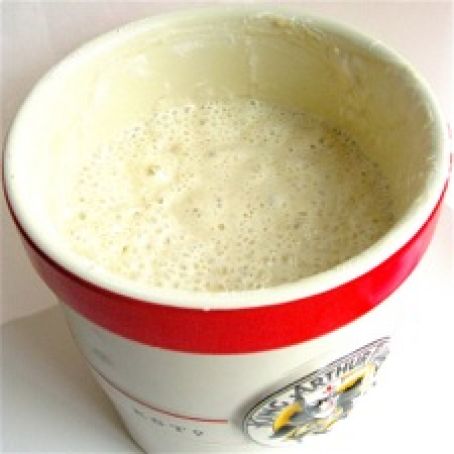
I made sourdough pancakes this morning, yummy. I have had sourdough starter for years but remember to feed it.
 1 Picture
Ingredients
- 1 cup whole rye (pumpernickel) or whole wheat flour
- 1/2 cup cool water
- To feed your starter
- a scant 1 cup King Arthur Unbleached All-Purpose Flour
- 1/2 cup cool water (if your house is warm), or lukewarm water (if your house is cool)
- note: best to use bottled water
Details
Servings 1
Preparation time 80mins
Cooking time 70mins
Adapted from kingarthurflour.com
Preparation
Step 1
1) Day 1: Combine the pumpernickel or whole wheat flour with the cool water in a non-reactive container. Glass, crockery, stainless steel, or food-grade plastic all work fine for this.
2) Stir everything together thoroughly; make sure there's no dry flour anywhere. Cover the container loosely and let the mixture sit at warm room temperature (about 70°F) for 24 hours. See "tips," below, for advice about growing starters in a cold house.
3) Day 2: You may see no activity at all in the first 24 hours, or you may see a bit of growth or bubbling. Either way, discard half the starter (4 ounces, about 1/2 cup), and add to the remainder a scant 1 cup King Arthur Unbleached All-Purpose Flour, and 1/2 cup cool water (if your house is warm); or lukewarm water (if it's cold).
4) Mix well, cover, and let the mixture rest at room temperature for 24 hours.
5) Day 3: By the third day, you'll likely see some activity — bubbling; a fresh, fruity aroma, and some evidence of expansion. It's now time to begin two feedings daily, as evenly spaced as your schedule allows. For each feeding, weigh out 4 ounces starter; this will be a generous 1/2 cup, once it's thoroughly stirred down. Discard any remaining starter.
6) Add a scant 1 cup (4 ounces) King Arthur Unbleached All-Purpose Flour, and 1/2 cup water to the 4 ounces starter. Mix the starter, flour, and water, cover, and let the mixture rest at room temperature for approximately 12 hours before repeating.
7) Day 4: Repeat step #6.
8) Day 5: Repeat step #6. By the end of day #5, the starter should have at least doubled in volume. You'll see lots of bubbles; there may be some little "rivulets" on the surface, full of finer bubbles. Also, the starter should have a tangy aroma — pleasingly acidic, but not overpowering. If your starter hasn't risen much and isn't showing lots of bubbles, repeat step #6 on day 6, and day 7, if necessary — as long as it takes to create a vigorous (risen, bubbly) starter.
9) Once the starter is ready, give it one last feeding. Pour off all but 4 ounces (a generous 1/2 cup). Feed as usual. Let the starter rest at room temperature for 6 to 8 hours; it should be active, with bubbles breaking the surface.
10) Remove however much starter you need for your recipe (no more than 8 ounces, about 1 cup); and transfer the remaining 4 ounces of starter to its permanent home: a crock, jar, or whatever you'd like to store it in long-term. Store this starter in the refrigerator, and feed it regularly; we recommend feeding it with a scant 1 cup flour and 1/2 cup water once a week.
Yield: starter for one typical recipe, on an ongoing basis.
Review this recipe