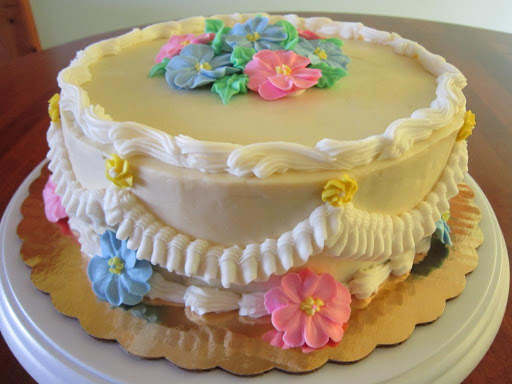
Buttercream Icing by Craftsy 3
By RoketJSquerl
Icing is best for decorating when made one or two days before use. Icing must be stored in airtight containers, but no refrigeration is necessary. It will last up to three weeks at room temperature. It can be refrigerated or frozen for longer storage.
 1 Picture
Ingredients
- SMALL BATCH:
- For smaller KitchenAid mixers:
- 2 pounds (900 gm) confectioners’ sugar
- 1/3 to 1/2 cup (79 ml to 118 ml) warm water
- 2 teaspoons clear vanilla flavoring
- 1 teaspoon near-colorless butter flavoring
- 3/8 teaspoon popcorn (fine-grain) salt, if not available, omit salt
- 1 pound or 2 cups (450 gm) vegetable shortening (Sweetex brand is recommended. Sweetex is a high-ratio shortening.)
- BIG BATCH:
- Using the 5-quart KitchenAid mixing bowl (recipe used in class):
- 5 pounds (2.3 kg) confectioners’ sugar
- 1 1/4 to 1 1/2 cups (296 ml to 355 ml) warm water
- 1 tablespoon + 2 teaspoons clear vanilla flavoring
- 2 teaspoons near-colorless butter flavoring
- 1 teaspoon popcorn (fine grain) salt, if not available, omit salt
- 2 1/2 pounds or 5 cups (1.13 kg) vegetable shortening (Sweetex brand is recommended.)
Details
Preparation
Step 1
TIP: It may be necessary to increase or decrease the amount of water in either recipe depending on the relative
humidity or the intended use of the icing. The icing should be firm enough to create the intended decorations.
Measure confectioners sugar into mixing bowl. Pour water, clear vanilla, near-colorless butter flavoring, and popcorn salt over powdered sugar and stir gently by hand. After sugar has settled, add one-third of the shortening.
Using the mixer’s beater/paddle (not the wire whip), begin mixing on low speed until blended then turn mixer to medium speed and mix for one to two minutes. If icing forms a ring around the top of the bowl, it
needs more water. Add more water a tablespoon at a time until no ring forms. (Icing will soften more when the remainder of the shortening is added.)
Scrape down the bowl to remove any sugar residue on sides and bottom. Start mixing again on medium speed and continue to mix until icing is smooth (with absolutely no lumps).
TIP: Before the remainder of the shortening is added, the icing may be mixed as long as necessary to get rid of sugar lumps. (With the mixer off, run a finger through icing to check for lumps). Once the remaining
shortening is added, the friction from overmixing will breakdown (melt) the shortening and cause soft, grainy icing. Be sure to get rid of any lumps in the first mix. It usually takes two or more minutes of mixing to achieve smooth icing, but mix as long as necessary during this stage to get the icing smooth.
Mixing Directions:
Once the icing is smooth, add remaining two-thirds of shortening and beat at high speed for two to three minutes or until shortening is well mixed and volume has increased. If the icing is too firm for its intended
use, add more water a tablespoon at a time. Do not overmix or icing will be soft and grainy.
TIP: When removing finished icing from the mixing bowl, be sure to avoid scraping any heavy residue that may still be on the bottom or sides of the bowl. This will be lumpy and clog the decorating tips.
TO CREAM ICING FOR FROSTING CAKES OR BORDERS:
Fill the mixing bowl until the icing covers the top of the beater/paddle.
The icing should be a soft consistency. If it is firmer, add more water one tablespoon at a time. Turn the mixer on low and mix until the icing is creamy and fluffy. It usually takes around four to five minutes.
TIP: Do not cream icing that will be used for flowers, figure piping, or other designs that require firm icing. Creamed icing is too soft for these techniques.
Review this recipe