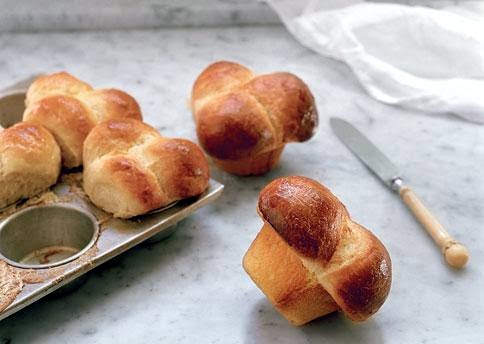
Bubble Top Brioche
By JennyMac
Nutritional Information
One serving contains the following:
Calories (kcal) 235.7
%Calories from Fat 49.6
Fat (g) 13.0
Saturated Fat (g) 7.6
Cholesterol (mg) 101.2
Carbohydrates (g) 24.1
Dietary Fiber (g) 0.7
Total Sugars (g) 4.5
Net Carbs (g) 23.4
Protein (g) 5.4
Those of you who didn't cut history (or French) might recall that when the young queen was told that the peasants of her land didn't have enough bread, she was quoted as quipping: "Qu'ils mangent de la brioche," or "Let them eat [rich, buttery, impossible-for-ordinary-citoyens-to-afford, and oh so beautiful] brioche."
Brioche is yeast's most elegant achievement. Best known as a morning treat (the small buns keep company with croissants at a French breakfast), brioche is part bread, part cake. The milk, eggs, sugar, and butter come from the sweet kitchen, the yeast comes from the bread baker's pantry, and the texture comes from heaven—gently pull at a piece and it stretches into lacy strands.
My guess is that the pastry cooks at Versailles had the same equipment for making brioche that the instructor of our baking class gave us: a bowl and a wooden spoon. We had to supply the elbow grease—and you need a lot of it to make brioche by hand, since it takes more than half an hour of beating the heavy, sticky dough to turn it into something so satiny you want to pet it. It's tough work, and the whole time I beat that dough and cursed the teacher, I wondered why the palace cooks hadn't started the revolution.
But here's the truth—after transforming that dough from a mound of ordinary ingredients into a bread worthy of royalty, brioche is mine. I own it. I could make it blindfolded if I had to. And, 30 years later, it's still my favorite dough to make—in a heavy-duty mixer.
Since I don't believe that just because I suffered through Brioche 101 you've got to, too, I'm about to tell you everything I learned, and everything you need to know to ace it.
New yeast rises best
Use regular active dry yeast, not rapid-rise or quick-rising, and check the expiration date. I know it sounds obvious, but it's important. Temperature matters
Dissolve the yeast in liquids that are warm to the touch. Think Goldilocks: not too hot, not too cold, just about 110°F. And have your eggs and butter at room temperature. Texture matters, too
The butter should be malleable, not mushy, and the same consistency as the dough. If it's too hard, squeeze each little pat between your palms—it's messy, but kind of fun and very effective. Mixing matters almost most of all
It's mixing and then even more mixing that give brioche its exquisite texture. Don't skimp here. Take time with the butter
It's not the butter's fault that it's slow to blend with the dough. Add it a few pieces at a time, and don't panic if it makes your beautiful dough fall apart—it'll all come together with more mixing. Listen to your dough
The dough will wrap itself around the dough hook and slap itself around the bowl. Keep your ears open for that slapping sound—it's the sign that all's right with the dough. Be patient
Brioche needs time in the mixer, time to rise, an overnight chill, more rising time, and time to cool just a little before you tear into it—cooling helps set its luxurious texture. I love using the dough for a sugar tart, a circle of brioche baked with custard, and I've created my own shape for the buns, making them bubble-topped, so they look like feather-light Frenchified Parker House rolls (that recipe is below). But if you fall hard for the dough, I know you'll find other ways to use it—it makes great raisin pinwheels and beautiful loaves. Leftovers are the stuff of French-toast dreams.
 1 Picture
Ingredients
- Ingredients
- 1/4 cup warm water (110°F to 115°F)
- 1/4 cup warm whole milk (110°F to 115°F)
- 3 teaspoons active dry yeast (measured from two 1/4-ounce envelopes)
- 2 3/4 cups all purpose flour
- 1 1/2 teaspoons salt
- 3 large eggs, room temperature
- 3 tablespoons sugar
- 12 tablespoons (1 1/2 sticks) unsalted butter, room temperature
- 1 large egg beaten to blend with 1 teaspoon water (for glaze)
Details
Servings 12
Adapted from bonappetit.com
Preparation
Step 1
Preparation
Combine 1/4 cup warm water and warm milk in bowl of heavy-duty mixer fitted with paddle attachment. Sprinkle yeast over and stir to moisten evenly. Let stand until yeast dissolves, stirring occasionally, about 8 minutes.
Add flour and salt to yeast mixture. Blend at medium-low speed until shaggy lumps form, scraping down sides of bowl occasionally, 1 to 2 minutes. Add eggs, 1 at a time, beating until blended after each addition. Beat in sugar. Increase mixer speed to medium; beat until dough is smooth, about 3 minutes.
Reduce speed to low. Add butter, 1 tablespoon at a time, beating until blended after each addition, about 4 minutes (dough will be soft and silky). Increase speed to medium-high and beat until dough pulls away from sides of bowl and climbs paddle, 8 to 9 minutes.
Lightly butter large bowl. Scrape dough into bowl. Cover bowl with plastic wrap. Let dough rise in warm draft-free area until almost doubled in volume, about 1 hour 15 minutes to 1 hour 30 minutes.
Gently deflate dough by lifting around edges, then letting dough fall back into bowl, turning bowl and repeating as needed. Cover bowl tightly with plastic wrap and chill, deflating dough in same way every 30 minutes until dough stops rising, about 2 hours. Chill overnight. (At this point, use the dough to make 12 brioches, or 6 brioches and 1 tart, or 2 tarts.)
Butter 12 standard (1/3-cup) muffin cups. Divide dough into 12 equal pieces; cut each piece into thirds. Roll each small piece between palms into ball. Place 3 balls in each prepared cup (dough will fill cup).
Place muffin pan in warm draft-free area; lay sheet of waxed paper over. Let dough rise until light and almost doubled (dough will rise 1/2 inch to 1 inch above top rim of muffin cups), 50 to 60 minutes.
Position rack in center of oven and preheat to 400°F. Place muffin pan on rimmed baking sheet. Gently brush egg glaze over risen dough, being careful that glaze does not drip between dough and pan (which can prevent full expansion in oven).
Bake brioches until golden brown, covering with foil if browning too quickly, about 20 minutes. Transfer pan to rack. Cool 10 minutes. Remove brioches from pan. Serve warm or at room temperature.
Review this recipe