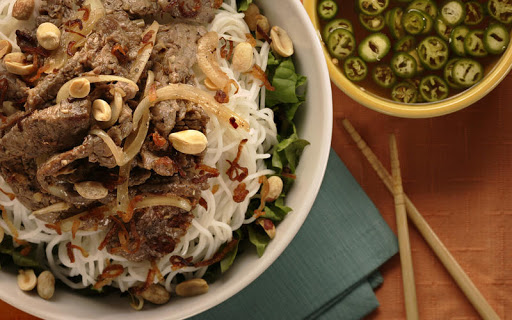
Rice noodle bowl with stir-fried beef (bun thit bo xao)
By gregofla
 1 Picture
Ingredients
- 1/3 cup fresh lime juice (2 to 3 limes)
- 1 tablespoon unseasoned Japanese rice vinegar (optional)
- 3 tablespoons sugar
- 2/3 cup lukewarm water
- 5 to 6 tablespoons fish sauce, or to taste
- 2 or 3 Thai or serrano chiles, thinly sliced
- 1/2 cup thinly sliced shallot, from 1 very large or 2 to 3 smaller shallots
- 3 tablespoons canola or other neutral oil
- 1 teaspoon cornstarch
- 3/4 teaspoon sugar
- 1/4 teaspoon salt
- 1/2 teaspoon black pepper
- 1 teaspoon fish sauce
- 2 tablespoons light (regular) soy sauce
- 1 pound flank steak, cut across the grain into strips about 3 inches long and a scant 1/4 inch thick
- Leaves from 1/2 small head red or green leaf lettuce, cut crosswise into 1/4 -inch wide ribbons (about 2 packed cups)
- 1 pickling (Kirby) cucumber or 1/2 small English cucumber, halved lengthwise, seeded and cut into matchsticks
- 2 cups bean sprouts (about 1/3 pound)
- 1/3 cup roughly chopped assorted fresh herbs such as cilantro, mint, red perilla (tia to), Thai basil (hung que) and Vietnamese balm (kinh gioi)
- 2/3 pound small dried round rice noodles (bun), cooked in boiling water for 3 to 5 minutes, drained and flushed with cold water
- 3 tablespoons canola or other neutral oil, divided
- 1 small yellow onion, halved and sliced lengthwise 1/4 -inch thick (aim for a moon-sliver shape and the onion will look really nice)
- 3 cloves garlic, finely chopped
- 1/2 cup unsalted roasted peanuts, coarsely chopped
- 1/3 cup crispy caramelized shallot
- 1 1/2 cups basic dipping sauce
Details
Servings 4
Adapted from recipes.latimes.com
Preparation
Step 1
Recipe: Rice noodle bowl with stir-fried beef (bun thit bo xao) - California Cookbook
Rice noodle bowl with stir-fried beef (bun thit bo xao)
At this time of year, like many cooks, I'm obsessed with fresh herbs. But you can keep your Genovese basil, French tarragon and Italian parsley; for me the magic is in the leafy aromatics of the Vietnamese table -- red perilla, garlic chives and rice paddy herb, to name just a few. I grow the herbs in my garden as well as purchase them by the bunch at farmers markets and Asian markets to ensure that I savor as much as I can during their peak hot-weather season.
Fresh herbs are essential to Vietnamese cuisine; their flavors and perfumes enliven countless foods. Pinched off their stems or chopped, raw leaves are tucked into rice paper rolls, dropped into hot soup, mixed into cool salads, stir-fried with noodles and wrapped up with grilled morsels in lettuce. Vietnamese people enjoy large quantities of fresh herbs, and in fact, herbs are collectively known as rau thom, which means "fragrant vegetable."
Consider their role in pho noodle soup: The ubiquitous national dish of Vietnam depends on the last-minute addition of herbs, without which the flavors would seem off and the dining experience would feel incomplete.
Heady beef pho, redolent of star anise and cinnamon, benefits from the bright notes of chopped cilantro that the cook sprinkles atop the hot broth right before the bowl leaves the kitchen. Then at the table, there are more herbs involved as diners add their personal touches with torn leaves of Thai basil, culantro or mint; dropping in extra herbs while working toward the bottom of the bowl is fine too.
Aside from contributing to the symphony of flavors in the mouth, some fresh herbs aid digestion, while others are Vietnamese folk remedies for fever, colds and headaches. When you combine the herbs with chiles, spices and aromatics such as ginger, galangal and turmeric, which all boast their own health benefits, you have a potent phytochemical mix.
Verdant Vietnamese balm (kinh gioi, Elshotzia ciliata) is my favorite Vietnamese herb, its delicate saw-edged, fuzzy leaves have an uncommon lemon grass- or lemon verbena-like quality. The assertive flavors of these two herbs stand up well to grilled meats and are terrific additions to rice paper rolls, lettuce wraps and bun rice noodle bowls.
Small plastic bags often hold charming rice paddy herb (rau om, Limnophila aromatica), its stems and small rounded leaves packed with citrus and cumin notes that pair well with curries and tamarind-inflected seafood soups. Heart-shaped wild betel leaf (la lot, Piper sarmentosum ), classically paired with beef, is either on Styrofoam trays or in small bunches.
Peruse the leafy greens section to find large bunches of flat, long green blades of Chinese chives (he, Allium tuberosum). Hard-core Vietnamese cooks tuck a few raw chives into their goi cuon rice paper rolls to add a mild garlicky bite. During the summer when Chinese chives are abundant and very well-priced, I harvest and purchase humongous bunches to stir-fry with flat rice noodles, pork and shrimp, a childhood favorite of mine.
Vietnamese cuisine is not one to stand still for long, and in recent years, Vietnamese Americans longing for the tartness of star fruit have found a worthy substitute in sorrel (rau chua, Rumex acetosa), and enjoy it with grilled and fried foods. In Vietnam, tender stalks of cutting celery (rau can, Apium graveolens) that resemble Italian flat-leaf parsley have recently appeared on the scene as a pungent addition to favorites such as crisp lotus stem salad.
When buying plants, try to connect with the vendors for more secrets. For example, I've had difficulty with rice paddy herb (rau om). I used to cover the container with a plastic bag to create a tiny greenhouse but eventually scorched the poor plant.
This year, I have a bumper crop of rice paddy herb and in addition to using it for traditional Vietnamese fare, I have experimented by including it in tabbouleh, quinoa and guacamole. One friend even suggests imbuing mojitos with Vietnamese balm.
In a small bowl, combine the lime juice, vinegar, sugar and water and stir to dissolve the sugar. Taste and adjust the flavors to balance the sweet and sour as needed.
Add the fish sauce, starting with 5 tablespoons and then adding more as your palate dictates, balancing the sour, sweet and salty. How much you use depends on the brand and your own taste. Aim for a light honey or amber color and a bold, forward finish. Keep in mind that this sauce is typically used to dress dishes that include unsalted ingredients such as lettuce and herbs -- ingredients that will need an extra flavor lift. When you're satisfied, add the chile. (If diners are sensitive to chile heat, serve the chiles on the side.) The sauce may be prepared early in the day and left at room temperature until serving. This makes about 1 1/2 cups dipping sauce.
In a 10-inch skillet, heat the oil over medium-low heat. Add the sliced shallot and fry gently, stirring occasionally to ensure even cooking. After 5 to 6 minutes, when the shallot is fragrant and lightly golden, watch the progress closely, moving the slices frequently by stirring them or swirling the pan. During frying, the shallot slices will soften into a mass and then stiffen as they caramelize and crisp. When most of the slices are a rich golden brown, remove the pan from the heat. The total cooking time should be about 10 minutes. Using a slotted spoon, transfer the shallot slices to a paper towel-lined plate, spreading them out in a single layer. Discard the fragrant oil or reserve it for other uses.
When the shallot slices have cooled, crisped and darkened slightly, transfer them to a small bowl or plate. Left uncovered at room temperature, they will retain their crispiness for a good 8 hours. Even if they no longer rustle when you shake them, they are still tasty.
2/3 pound small dried round rice noodles (bun), cooked in boiling water for 3 to 5 minutes, drained and flushed with cold water
Marinate the beef: In a shallow bowl large enough to accommodate the beef, whisk together the cornstarch, sugar, salt, pepper, fish sauce and soy sauce until thoroughly combined. Add the beef and use chopsticks or your fingers to coat evenly. Set the mixture aside to marinate while you ready the bowls.
Make the salad mix: In a large bowl, combine the lettuce, cucumber, bean sprouts and herbs and toss well. Divide the salad among 4 noodle soup-sized bowls and top with a layer of noodles. Set the bowls aside while you stir-fry the beef.
To stir-fry a large quantity of meat successfully on a home kitchen stove, it is best to work in batches and then bring them together at the end. In a wok or large skillet, heat 1 tablespoon of the oil over medium-high heat. Add the onion and stir-fry until slightly soft and fragrant, 1 to 2 minutes. Add the garlic and stir-fry for about 15 seconds, or until aromatic. Transfer to a plate with a slotted spoon.
Increase the heat to high and add another tablespoon of oil. Add half of the marinated beef, spreading it out into a single layer. Cook the beef, undisturbed, until it begins to brown, about 1 minute, then flip and stir-fry it for an additional 1 to 2 minutes, or until it is still slightly rare. Transfer to the plate holding the onions and garlic. Repeat with the remaining 1 tablespoon oil and the second half of the beef. When the second batch is just about done, return the onion and garlic, the first batch of beef and any accumulated juices to the pan. Stir-fry for about 2 minutes to heat through and finish cooking the beef.
Remove from the heat and divide evenly among the bowls. Top with the peanuts and shallot. Serve immediately with the sauce for diners to dress and toss their own bowls.
Review this recipe