Kaiser Rolls
By á-30
 1 Picture
Ingredients
- bread flour, salt, diastatic malt powder (or barley malt syrup), instant yeast, egg, oil, and water. poppy seeds
Details
Preparation
Step 1
The ingredients can be stirred together by hand (I like to use a wooden spoon or dough whisk), or with the paddle attachment of a stand mixer. They should be mixed until the ingredients form a ball and there is no loose flour in the bottom of the bowl – a bit of extra water can be added if needed.
As I decided to knead the dough in the stand mixer, I switched to the dough hook once all the ingredients were well mixed. I might have accidentally added a bit too much water at the beginning because my dough was fairly wet and sticky, but I never mind starting with a sticky dough. It’s easier to knead extra flour into a dough if it’s too wet than to add extra water if the dough is too stiff.
Challenge: Kaiser Rolls
Jan 14th, 2010
Adventures in Baking
BBA Challenge
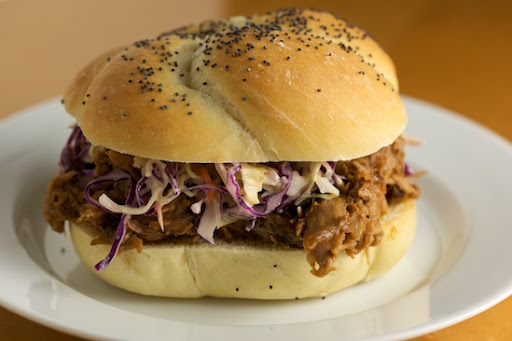
Roast Pork Sandwich on Kaiser Roll
We’re back to the Bread Baker’s Apprentice Challenge! Today I’m sharing my experience with the 16th bread in the challenge: Kaiser Rolls. I enjoyed these rolls so much I’ve made them twice already! Like many of the breads in the book, these rolls do take two days to make, but they aren’t difficult and I found that they were both easy and a lot of fun to shape.
Kaiser rolls, also called New York hard rolls or Vienna rolls, are known for the distinctive star pattern on the top of the roll. The traditional method for achieving the classic kaiser roll shape requires a series of overlapping folds that intimidates me quite a bit. Luckily, the book offers a couple of other options for creating beautiful kaiser rolls.
The first of the easier shaping options is to use a special kaiser cutting tool that stamps a star pattern right into the top of the shaped rolls before they are proofed. While this method appears to be the easiest, it requires the purchase of the specialized tool and quite frankly seems a bit boring. The other option is to make a knotted roll. The knot method appeals to me because it looks easier than the folding method, but is more hands-on than the stamping method.
Most commercial bakeries make these rolls using the faster direct-dough method, but Mr. Reinhart’s version uses a pre-ferment to improve the flavor, texture, and color. The pâte fermentée, or old dough, is mixed up on day one and allowed to ferment slowly and develop flavor in the refrigerator overnight (or longer).
Pate Fermentee for Kaiser Rolls
The following morning, or whenever you are ready to make the rolls, the old dough is taken from the fridge, chopped into pieces, and mixed into the new dough.
Kaiser Roll Ingredients
The dough ingredients should be quite familiar at this point in the challenge: bread flour, salt, diastatic malt powder (or barley malt syrup), instant yeast, egg, oil, and water.
Kaiser Roll Ingredients Mixed
The ingredients can be stirred together by hand (I like to use a wooden spoon or dough whisk), or with the paddle attachment of a stand mixer. They should be mixed until the ingredients form a ball and there is no loose flour in the bottom of the bowl – a bit of extra water can be added if needed.
Kaiser Roll Dough Ready for Kneading
As I decided to knead the dough in the stand mixer, I switched to the dough hook once all the ingredients were well mixed. I might have accidentally added a bit too much water at the beginning because my dough was fairly wet and sticky, but I never mind starting with a sticky dough. It’s easier to knead extra flour into a dough if it’s too wet than to add extra water if the dough is too stiff.
I kneaded the dough for about 7 minutes, adding small amounts of flour until the dough seemed right – soft and supple, tacky but not sticky. I checked the gluten development using the windowpane test, and it looked great.
I placed the kneaded ball of dough into an oiled bowl, turning it once to coat both sides with oil in order to prevent the dough from drying out during the bulk fermentation stage.
According to the book, the dough temperature after kneading should be between 77 and 81 degrees F. It was close, but a little on the cool side. My house was also fairly cool, so I knew there was a possibility that the two hour fermentation time might need to be extended a bit if the dough hadn’t doubled in that time. However, the dough appeared to have doubled after two hours, so I continued to the dividing and shaping phase.
The dough can be divided into 6 pieces for larger rolls, or 9 pieces for smaller rolls. I decided to divide it into 8 pieces – it just seemed easier to divide the pieces into an even number. I used my scale to make sure they were all close to the same weight so the rolls would be uniform in size.
As the dough was divided and measured, I pre-shaped the pieces into rounds and let them rest for ten minutes. The resting period is important because it lets the gluten relax, allowing for easier stretching and shaping.
Next it was time to shape the rolls into knots. Using my hands, I rolled a ball of dough into a rope.I tied the rope into a simple knot, leaving a bit of length at each end. As you can see, the rope shrunk as I tied the knot. Luckily, the dough is elastic and it was easy enough to stretch it and complete the shaping. To finish the knot, I pulled the right end of the rope up and over, and tucked it into the center. Next, I took the left end of the rope and pulled it down and under, pushing it through the bottom of the knot and up into the center.
It’s hard to show the process using photos, but this is what a knotted kaiser roll will look like. The little nub in the center is from the left strand that was wrapped under and pushed up through the center of the knot. Some of mine ended up with the little nub in the center, some didn’t. The process was simple to learn using the photos and instructions in the book, and once I completed the first one, I breezed through the rest without any problems.
The shaped rolls were placed on a baking sheet, covered with plastic and allowed to proof at room temperature for about an hour and 15 minutes.
They were supposed to double in size, but I’m not sure if mine quite made it. I was tired of waiting and my oven was pre-heated and ready to go, so I decided to bake them anyway. Right before placing the tray in the oven, I sprayed the rolls lightly with water and sprinkled seeds on top. The first time I made the rolls, I used only poppy seeds, but this time I topped some with poppy seeds, some with sesame seeds, and a few with both.
The rolls were baked for about 25 minutes, until the internal temperature reached 200 degrees. The crusts were thin and crisp, and the insides were soft – perfect for a sandwich roll!
Review this recipe