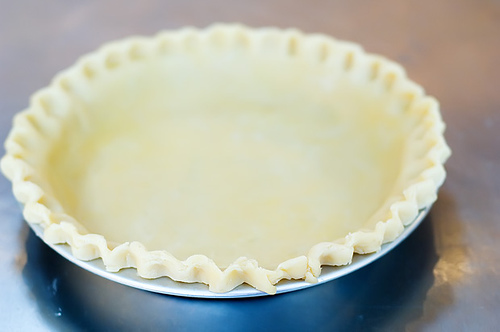
Sylvia’s Perfect Pie Crust
By Addie
I receive recipes from readers quite frequently, and I read each and every one. I figure if someone’s going to take the time to type out and email me a recipe, it’s probably pretty dadgum good. I have a folder building of the reader recipes I plan to try in the new year, but the one I couldn’t wait to test out was this pie crust recipe, sent to me by Sylvia L., a reader. I’d seen different permutations/combinations of this recipe before—in fact, I believe my mom’s “Perfect Pie Crust” uses these same ingredients. Something dear Sylvia suggested, though, really caught my eye: “You can even make them ahead of time and freeze them,” she said. “The crusts turn out even flakier!”
I really love flaky pie crust, and it’s always been a difficult quality for me to achieve, despite most people’s claims that their recipe is THE flakiest pie crust in existence. I was intrigued, and decided to try Sylvia’s recipe and method here in plain sight. You’ll get to see the results in the next post, but for now let’s MAKE this blessed, beautiful pie crust, shall we? (Ree Drummond - The Pioneer Woman)
 1 Picture
Ingredients
- 1 1/2 cup Crisco (vegetable Shortening)
- 3 cups All-purpose Flour
- 1 whole Egg
- 5 Tablespoons Cold Water
- 1 Tablespoon White Vinegar
- 1 teaspoon Salt
Details
Preparation
Step 1
In a large bowl, with a pastry cutter, gradually work the Crisco into the flour for about 3 or 4 minutes until it resembles a coarse meal. In a small bowl, beat an egg with a fork and then pour it into the flour/shortening mixture. Add 5 tablespoons of cold water, 1 tablespoon of white vinegar and 1 teaspoon of salt. Stir together gently until all of the ingredients are incorporated.
Separate the dough into thirds. Form 3 evenly sized balls of dough and place each dough into a large Ziploc bag. Using a rolling pin, slightly flatten each ball of dough (about ½ inch thick) to make rolling easier later. Seal the bags and place them in the freezer until you need them. (If you will be using it immediately it’s still a good idea to put in the freezer for about 15 to 20 minutes to chill.)
When you are ready to use the dough to make a crust, remove from the freezer and allow to thaw for 15 minutes. On a floured surface roll the dough, starting at the center and working your way out. (Sprinkle some flour over top of the dough if it’s a bit too moist.) If the dough is sticking to the countertop use a metal spatula and carefully scrape it up and flip it over and continue rolling until it’s about ½ inch larger in diameter than your pie pan.
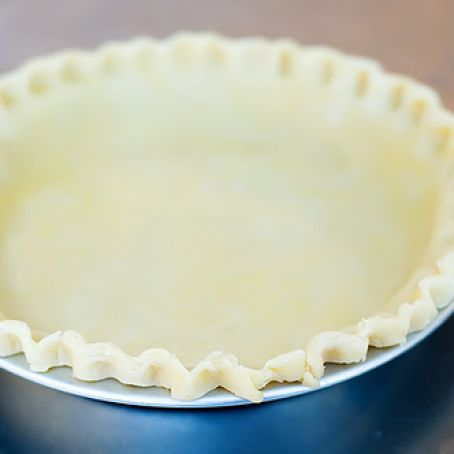
With a spatula, lift the dough carefully from the surface of the counter into the pie pan. Gently press the dough against the corner of the pan. Go around the pie pan pinching and tucking the dough to make a clean edge.
..........................
COMMENTS:
Will go and make my apple pie right now and tell you how it turns out. The recipe is similar to my own that my ex-chef husband gave to me. Very flaky. I use grease proof paper to roll my pastry out on as you can then pick it up and roll it out over the pie dish without any hassles and also no mess on my stainless steel bench to clean up. How much sugar such I add to make it sweet? I’m thinking about 1/2 cup of icing sugar. Will see how it goes. Hope I don’t stuff it up.
My Grammy who makes the world’s best piecrusts, IMHO, always, always, ALWAYS freezes her crusts. And I’ve seen that a slightly tough recipe can be changed by the freezing. Once I made a double batch of dough, rolled it out and cooked one pie up, used the second crust which was rolled out ahead of time and frozen later that night. The frozen one was wonderful!
My sister in law uses this recipe and her pie crusts are very flaky. I have never heard the freezing thing and will have to try it the next time I make pie.
You know if you don’t like using one of those darn pastry cutters to cut in the shortening, you can cheat. I use the whisk attachment on my kitchen aid mixer because I’m sort of lazy that way. With the mixer on medium speed you cut that shortening in in no time flat.
That is pretty darn close to my hubby’s families secret pie crust recipe. Best crust ever!
I am Sylvia’s daughter and I can attest first hand that this pie crust is amazing! I think I could even eat the crust all by itself.
Oh my gosh, this is the pie crust recipe my mom used when I was growing up! Thanks so much for posting it. It’s amazing stuff. I used to eat it by itself, uncooked, like cookie dough.
Just ate the pie and the crust was better than my recipe YUM. Very flaky and nice.
This is the recipe I use (when I don’t by the kind with the fat little doughboy on the package) EXCEPT I use Butter Flavor Crisco. Don’t know if it really tastes all that different, but it gives it a nice color that I like for some strange reason.
Believe me, this is a no-fail pie crust. As a pretty good cook, I struggled with various pie crust recipes for years(some using half butter/half shortening)until my husband handed this very recipe over….written in his mother’s own hand. The only difference is that I combine the egg, water and vinegar before adding. You made an excellent point, Ree, about not trying to make it perfect….and NOT overmixing it…that’s still my tendency.
You had me until the egg and vinegar. I don’t know about that but you haven’t steered me wrong yet so I might just give it a try. What I do want to tell you is that I freeze my pie crust all the time. I usually have a few crusts in the freezer and then if I want to make a pie that part is already done. Simple and organized!
This is very similar to a recipe I have used for years. I got mine from a tupperware party I attended. I agree with other readers that egg and vinegar are strange additions – but they work. Two things that I swear that makes the crust best is the use of crisco (nothing else) and ice water. When I freeze it I put it in a zip lock bag and press it all the the way to corners to push out any air.
That’s the same recipe my great-grandmother has passed down. Love it and I freeze it also. But since I don’t do that much baking or cooking I don’t have one of those fancy little pastry cutters. I just use two table knives. Cut the crisco into the flour till you have the chunks. You get the same end result just may take a little longer.
Try making your pie crust in the food processor. My mom always told me the less you touch it, the better it is. The blades really work all that shortening in really well. I haven’t made crusts any other way since I tried this!
I’ve used this recipe for 35 years. Perfect results–every time!
I use my hands. I have a pastry cutter but I never use it. I just run my hands through the flour and shortening over and over working it together.
Sylvia L. On Monday, December 24 at 8:00 pm
Christmas Eve greetings to everyone!
Thank you so much, Ree, for using my pie crust recipe on your web site. Thanks also to all the readers for your positive comments. I know the egg and vinegar may have thrown a few of you off, but they really help to make the crust flaky and tender. I was fortunate to have been given this recipe 33 years ago, and it has been very popular in the family all those years.
A few extra comments might be of assistance. Always start with cold ingredients. Also, I use a pastry blender/cutter, not a machine, to blend the Crisco and flour, as Ree said. Then gently stir in the other ingredients, just until everything holds together, and divide into three balls.
You can use what is called a pie crust shield, a round metal ring that rests over the crust and on the pan, to cover the finished outer crust so that it won’t become over cooked, or cover with tin foil. When the outer crust is protected, I can let the pie bake a couple of extra minutes to make sure the bottom crust is done and flaky as well.
I have a VERY different recipe that never fails, so I thought I’d pass it along, too. I’ve never frozen it, and the part that makes it especially fail-proof is the way it’s rolled out between two sheets of wax paper–I’m including a link to a photo post demonstrating it (although I’m kinda shy to pass along my version of a photo post…). Anyway, the wax paper trick might work for this one, too, and it’s amazing how it simplifies transfer.
Review this recipe