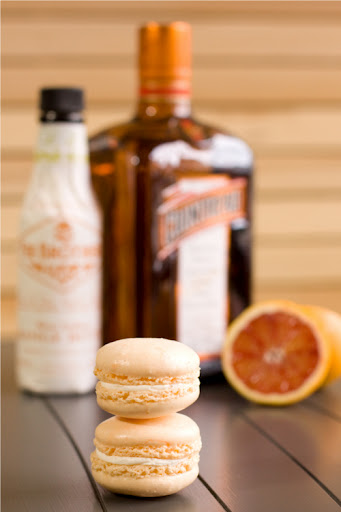
French Macaroons (variations below)
By stancec44
 1 Picture
Ingredients
- 4 ounces (115g) blanched almonds or almond flour, or whatever nut you like
- 8 ounces (230g) powdered sugar*
- 5 ounces egg whites (144g), temperature and age not important!
- 2 1/2 ounce (72g) sugar
- the scrapings of 1 vanilla bean or 2 tsp vanilla extract
- 1/2 tsp (2g) kosher salt
- approximately 10 ounces (290g) Swiss buttercream (see separate recipe)
Details
Adapted from bravetart.com
Preparation
Step 1
Preheat the oven to 300° and have ready a large (18”) pastry bag, fitted with a plain tip, along with two sheet pans lined with parchment paper.
I am hopelessly impatient and given to rushing, even when I know better. So to prevent my macarons from growing ever larger as I pipe, I use a 1 1/2” cookie cutter to trace out guide-circles (about an inch apart) and then I flip the parchment paper over, ink side down.
If you use almond flour, you lucky dog, simply sift it with the powdered sugar and set aside.
Otherwise, bust out your food processor. Process the almonds and powdered sugar for about a minute. Take out the mixture and sift it, reserving whatever bits don’t pass through the sieve. Add these bits back to the food processor and run the machine for another minute. Sift again. You should have about 2 Tbsp of slightly chunkier almond bits, but hakuna matata. Just add those into the dry mix.
In the bowl of a stand mixer, combine the egg whites, sugar, vanilla bean (not the extract), and salt and turn the mixer to medium (4 on a Kitchen Aid). Whip for 3 minutes. They will not seem especially foamy at that point.
Increase the speed to medium-high (7 on a Kitchen Aid) and whip another 3 minutes, then crank the speed to 8 for go another 3 minutes.
At that point, turn the mixer off and add in any extracts/flavor/color and whip for a final minute on the highest speed, just to show it who’s boss (and to evenly distribute the color/flavor).
At the end of this minute, you should have a very stiff, dry meringue. (Check out the photo on brave tart site if you’d like to see a picture of how your meringue should look.) When you remove the whisk attachment, there will be a big clump of meringue in the center, just knock the whisk against the bowl to free it. If the meringue has not become stiff enough to clump inside the whisk, continue beating for another minute, or until it does so.
Now dump in the dry ingredients all at once and fold them in with a rubber spatula. Use both a folding motion (to incorporate the dry ingredients) and a pressing motion, to deflate the meringue against the side of the bowl.
First timers: the dry ingredients/meringue will look hopelessly incompatible. After about 25 turns (or folds or however you want to call “a single stroke of mixing”) the mixture will still have a quite lumpy and stiff texture. Another 15 strokes will see you to “just about right.” Keep in mind that macaronage is about deflating the whites, so don’t feel like you have to treat them oh-so-carefully. You want to knock the air out of them.
Undermixed macaron batter: quite stiff. If you spoon some out and drop it back into the mix, it will just sit there and never incorporate. Do this test before bagging your batter and save yourself the trouble of baking of undermixed macarons!
Overmixed macaron batter: has a runny, pancake batter-like texture. It will ooze continuously, making it impossible to pipe into pretty circles. Um, try not to reach that point.
You can evaluate your batter one stroke at a time, no rush.
Essentially, the macaron batter needs enough thickness that it will mound up on itself, but enough fluidity that after 20 seconds, it will melt back down. I’ve heard people describe this consistency as lava-like, or molten, and that’s pretty apt.
Transfer about half the batter to a piping bag. (When your bag is too full, the pressure causes the batter to rush out in a way that’s difficult to control, making for sloppy macarons.)
Pipe the batter into the pre-traced circles on the baking sheet. Stop piping just shy of the borders of the circle, as the batter will continue to spread just a bit.
After piping your macarons, take hold of the sheet pan and hit it hard against your counter. Rotate the pan ninety degrees and rap two more times. This will dislodge any large air bubbles that might cause your macarons to crack
Bake for about 18 minutes, or until you can cleanly peel the parchment paper away from a macaron. If, when you try to pick up a macaron, the top comes off in your hand, it’s not done.
Once the macarons have baked, cool thoroughly on the pans, before peeling the cooled macarons from the parchment. Use a metal spatula if necessary.
Fill a pastry bag fitted with the buttercream of your choice and pipe a quarter sized mound of buttercream into half of the shells, then sandwich them with their naked halves.
Macarons, against all pastry traditions, actually get better with age. The shells soften and become more chewy, mingling with the flavor of the buttercream too. So, while of course you can eat them right away, don’t hesitate to store them refrigerated for up to a week. If at all possible, set them out at room temperature for a few hours before consuming, because cold buttercream is kinda gross.
*Cornstarch-laced powdered sugar isn’t a problem for macaron making, but it is a problem for Passover. You can buy cornstarch free powdered sugar here.
Variations
To make Champagne and Roses macarons: add in 1 1/4 tsp rose flower water and some red gel paste coloring during the final minute of whipping. Yes, rose water is usually doled by the drop, but the subtle flavor must compete with the flavor of the almonds and will also lose power in the oven.
Flavor 10 ounces of vanilla Buttercream with a 1/2 bottle (325 mL) Bubbly (something tasty, but not too high-end) that you’ve gently reduced to 3 ounces. Let this liquid cool to room temperature, before adding it a few spoonfuls at a time to the buttercream while it whips.
To make Chocolate Chestnut Macarons, replace 1 oz powdered sugar with 1 ounce cocoa powder and add 2 tsp espresso powder in with the almond flour. The espresso powder helps round out the simple chocolate flavor of cocoa without contributing a noticeable coffee flavor.
To make Strawberries and Cream Macarons, you’ll need to get a hold of freeze dried strawberries; I found mine at Whole Foods (or buy them online here). Conventionally dried strawberries will not work.
Begin by grinding 3/4 ounce freeze dried strawberries with the almond flour. Then add 1/2 tsp rose flower water and a touch of pink gel paste (optional) during the final minute of mixing.
To make white chocolate ganache for the filling, bring 6 ounces heavy cream to a simmer with a split vanilla bean. Shut off the heat and steep for 10 minutes or up to an hour. Remove the vanilla bean, scraping out the cream from inside each half-pod, and return the cream to a boil. Shut off the heat and whisk in 10 ounces good quality white chocolate, chopped and 1/2 tsp salt. Depending on the sweetness of your white chocolate, you may find you need more salt. Cool the mixture to room temperature, and then whip on medium speed with a whisk attachment for about 5 minutes to lighten it a bit. (Alternately you can use dark chocolate.)
Fill half the shells with the ganache and place a piece of freeze dried strawberry on top of each ganache mound before sandwiching.
To make Lavender Milk Chocolate Macarons, grind 1 Tbsp dried lavender in with the almond flour. If the lavender is very fresh, it may not grind easily. Grind more if needed. During the final minute of mixing add in a touch of lavender gel paste, if you like.
Fill the shells with 10 ounces of Milk Chocolate Swiss buttercream.
To make Bourbon Pecan Macarons, simply use pecans in place of the almonds and proceed with the recipe as normal.
Fill the shells with 10 ounces of Vanilla Swiss buttercream, spiked with as much bourbon as you can handle. The pecan macarons are quite sweet and rich, so they can really stand up to a boozy buttercream. I use about 2 ounces, but taste along the way and use as much or as little as you like.
To make Matcha Chocolate Macarons, sift in 1 Tbsp matcha powder with the dry ingredients.
Fill the shells with 10 ounces of dark chocolate ganache.
To make Hazelnut Chocolate Macarons, simply use toasted hazelnuts in place of the almonds, or hazelnut flour instead of almond flour. My hazelnut macarons do not contain any almond.
Fill the shells with 10 ounces of dark chocolate ganache or 8 ounces of Vanilla Swiss buttercream flavored with 2 ounces melted dark chocolate.
Review this recipe