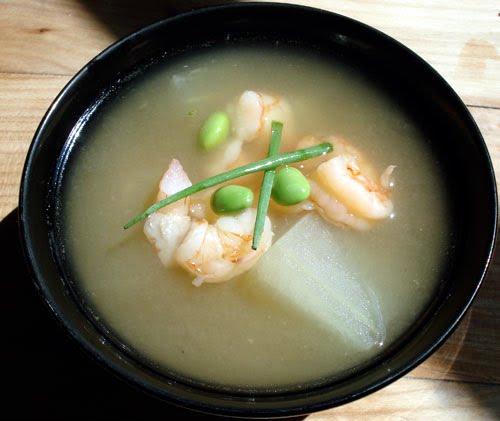
Japanese Basics: Dashi Stock
By RoketJSquerl
Dashi is the basic soup stock used in Japanese cooking. Unlike Western or Chinese basic stocks that rely on stewing meat or vegetables for a long time to extract the flavors, Japanese dashi can be quite quickly made. There are instant granules available, but like instant stock cubes they are high in sodium and stuff. Not that sodium is necessarily bad, but when it's so easy to make a real stock from scratch, why go for the fake stuff?
There are basic ingredients for making dashi. One is shaved bonito flakes, called katsuo bushi. You can also buy a whole, dried bonito and shave it on something that looks like a plane, but this is too much work for me. I just use the preshaved bonito flakes that come in big bags.
Dried kombu seaweed is the second ingredient. This is a leathery seaweed, that comes in large leaves. What I do is to cut up the leaves with scissors into approximately 4 inch lengths, pack them well in multiple layers of plastic bags and store them in the freezer.
The third commonly used ngredient is dried sardines, called niboshi. This produces the most distinctively flavored stock. I rarely use niboshi myself, simply because it's rather hard to get a hold of good, non-rancid niboshi here in Switzerland. If you have some niboshi, sniff it. If it smells strange, your stock will taste strange too. Cats love niboshi, either dried or after they've been used for stock.
Following my mother's example, I usually make a dashi using bonito flakes and kombu. This is also called ichiban-dashi - first stock. Frugal housewives often make niban-dashi - second stock - by re-extracting more goodness out of the kombu and bonito flakes already used for ichiban-dashi. Niban-dashi is fine to use for stewed vegetables and the like.
 1 Picture
Ingredients
- 1 4 Inch , piece dried kombu
- A Good Handful of Bonito Flakes
- 4 C Cold Water, from the tap (you might consider filtering it if it is too hard or chlorinated)
Details
Servings 2
Adapted from justhungry.com
Preparation
Step 1
Soak the dried kombu piece in 3-4 cups of cold water for about 20 minutes. Bring the water to the boil, then add the handful of bonito flakes. Immediately switch off the heat and let it sit for at least 5 minutes. Strain through a sieve, pressing out all the goodness.
Makes 3-4 cups.
The cold-water method
For the last couple of years, I've been using the _mizudashi_ method much more. This is the method I've described for making vegetarian dashi, except that I add some bonito flakes. I put a piece of kombu seaweed and a big handful of bonito flakes in a jug of cold water, and let it steep for at least a few hours or overnight. To use the dashi I simply strain it out. The dashi keeps in the fridge for a few days, and if I don't use it up during that time (which is rare) I just freeze it. Aside from having to remember to fill up a jug, this method couldn't be easier.
Niban dashi for stews and more
The two methods described above make _ichiban dashi_ (first dashi), which is the strongest in flavor. This is used for dishes where the dashi flavor is paramount, such as soups or dipping sauces. But for stews and other dishes where dashi is more of a background component, a frugal cook uses _niban dashi_ (second dashi). Since kombu and bonito flakes are so expensive outside of Japan, it really pays for those of us who live 'over the sea' to make _niban dashi_! To make this, simply re-simmer the kombu and bonito flakes you used for making _ichiban dashi_ for a while; this extracts a light flavored dashi. I freeze the kombu-bonito flakes clumps and use a couple of them at a time to make _niban dashi_.
Review this recipe